NASA’s Chandra pops the cosmic cork with a stunning view of the Champagne Cluster
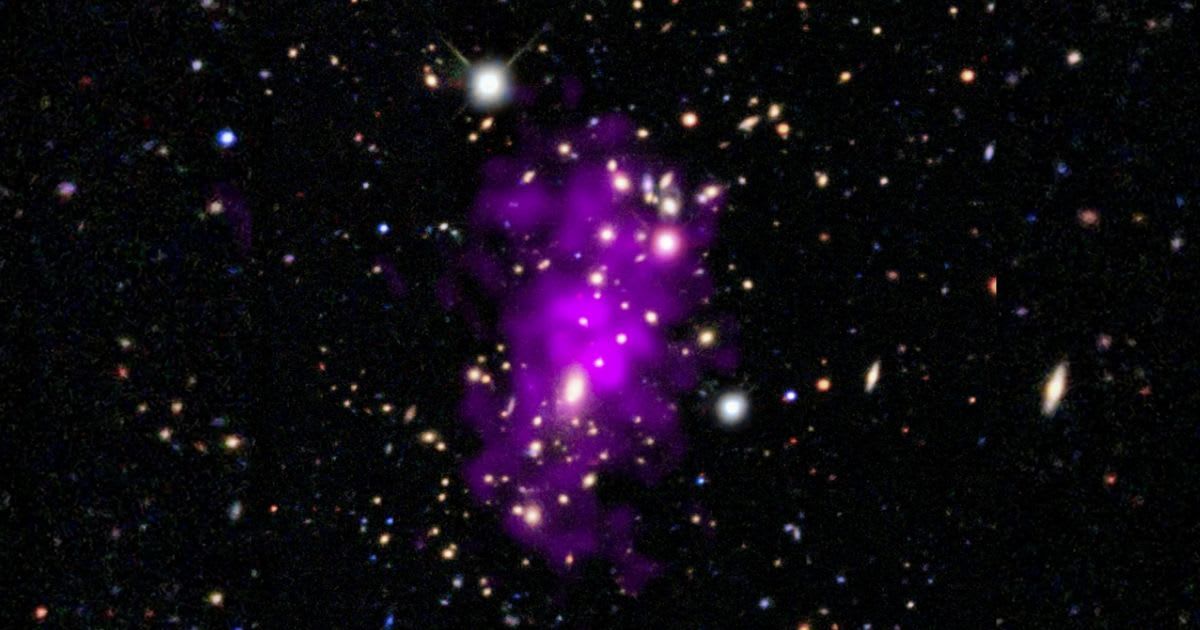
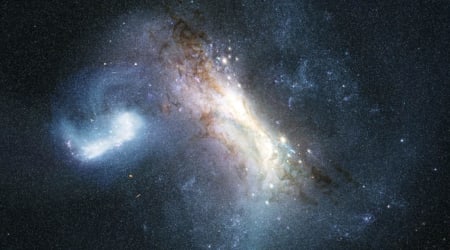
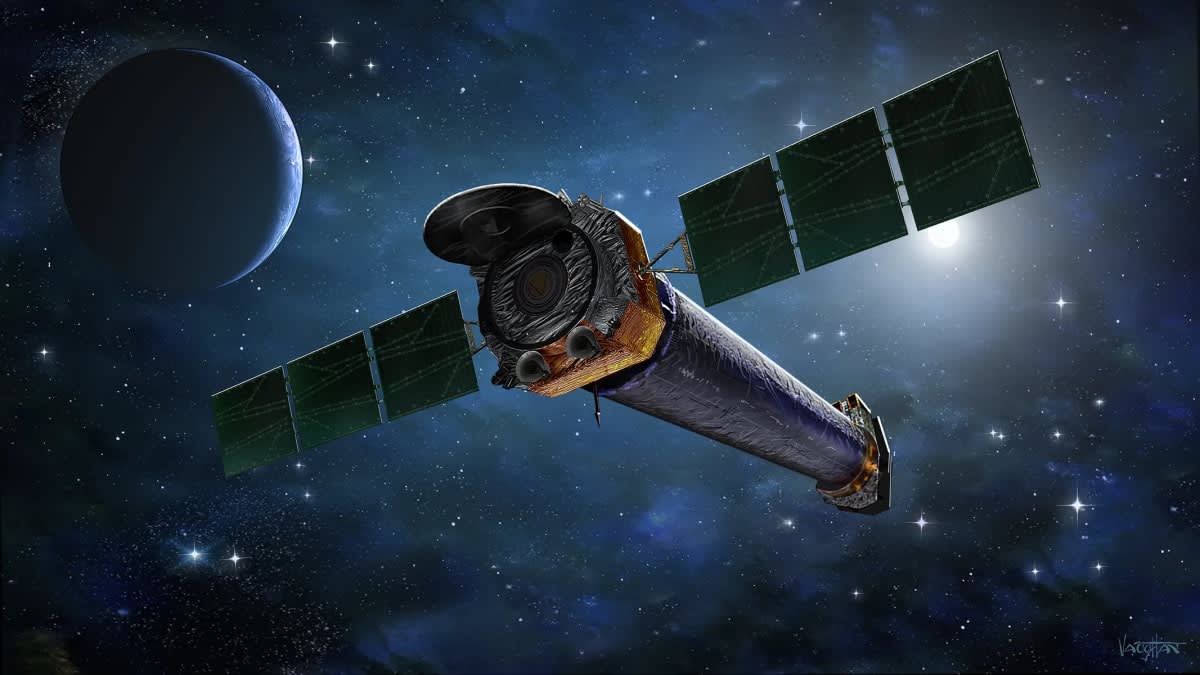
Thanks to data from NASA's Chandra Telescope, astronomers were able to create a brand new composite image of a rather intriguing galaxy cluster. This cluster was discovered on December 31, 2020. That specific date, along with the constituent galaxies arranged in bubble-like shapes and the large specks of purple, which are superheated gas, have led scientists to call it the 'Champagne Cluster,' which is far easier to remember and write than its official designation of RM J130558.9+263048.4. Faik Bouhrik, Rodrigo Stancioli, and David Wittman, all from the University of California, Davis, compiled their latest findings surrounding the new image in a research paper that is now available in The Astrophysical Journal.
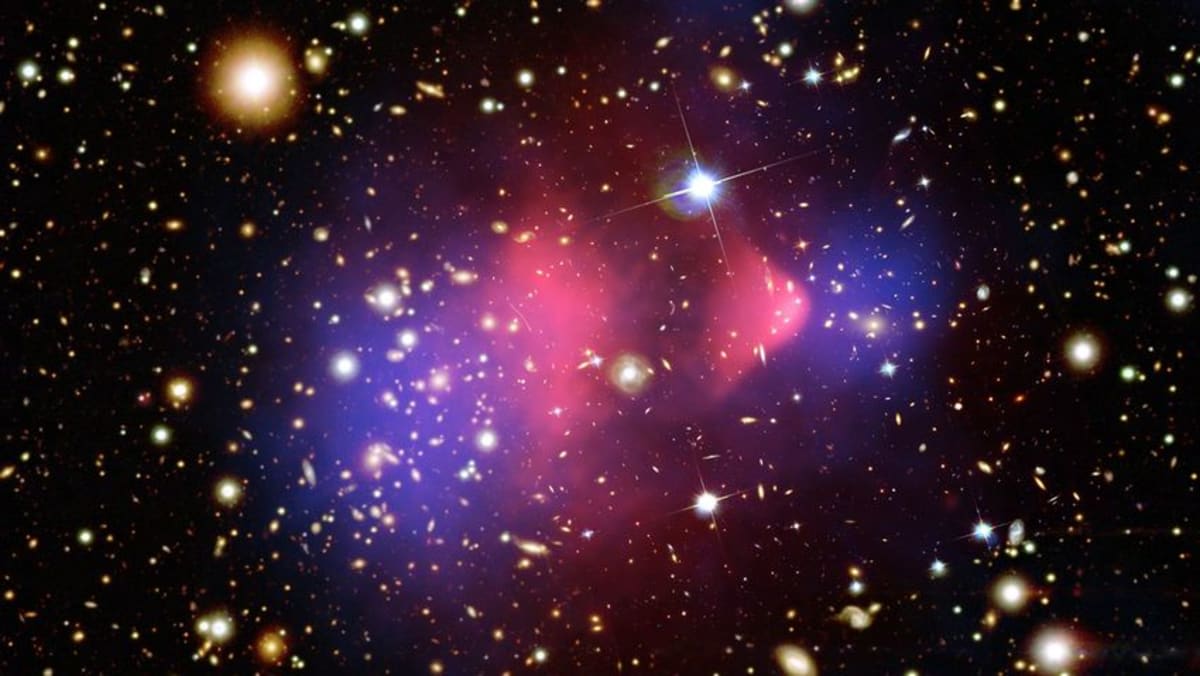
In addition to the Chandra data, the new image contains optical data from the Legacy Surveys (red, green, and blue), which consist of three individual and complementary surveys from various telescopes in Arizona and Chile. According to NASA, the Champagne Cluster is a member of a rare class of merging clusters, which includes well-known clusters like the Bullet Cluster. In such systems, the extremely hot gas from colliding clusters has slammed together and slowed, creating a noticeable offset between this gas and most galaxies within each cluster.
The newly released composite image shows that the Champagne Cluster is not a single cluster, but rather it is two galaxy clusters that are in the midst of merging into a much larger system. In most of the cases, the galaxy cluster's gas gets heated to millions of degrees, which appears roughly round or slightly elongated in images. In sharp contrast, the hot gas in the Champagne Cluster is stretched much farther from top to bottom, a clear sign of two clusters colliding.
Distinct concentrations of galaxies belonging to each cluster are visible above and below the center of the image. This blisteringly hot gas outweighs all of the cluster’s individual galaxies combined. Surrounding and shaping the system is an even larger reservoir of dark matter, a mysterious component that is thought to be present throughout the universe but hasn't been imaged yet, largely because it does not emit any radiation.
Coming to this cluster's origins, after carefully analyzing data alongside computer simulations, astronomers have proposed two possible scenarios for the Champagne Cluster. In the first scenario, more than two billion years ago, the two clusters crashed into each other. After that encounter, they moved apart from each other before gravity drew them back together, placing them in line for a second collision. In the second scenario, roughly 400 million years ago, the clusters experienced a single impact and, since then, have been drifting apart from each other. Astronomers believe that additional observations of the Champagne Cluster could provide valuable insight into how dark matter behaves during extremely fast cosmic collisions.
More on Starlust
NASA is tracking asteroid more than twice the size of Empire State Building as it approaches Earth
Astronomers confirm first triple system with actively feeding supermassive black holes