Meteor breaks apart and causes a loud ‘boom’ over Ohio, fireball seen across multiple US states

Residents of Valley City in the US state of Ohio heard a loud noise coming from the skies above in the morning hours of Tuesday, March 17, 2026. NASA attributed the noise to a meteor that was later confirmed to have been about 6 feet in diameter. It is said to have entered the atmosphere above Lake Erie, travelling at close to 45,000 miles per hour before it broke apart in an explosion equivalent to 250 tons of TNT. The Pittsburgh office of the National Weather Service shared a video captured by their employee showing the meteor arcing across the sky.
One of our employees, Jared Rackley, caught this morning's meteor on camera from the Pittsburgh area. pic.twitter.com/2LdqOpChti
— NWS Pittsburgh (@NWSPittsburgh) March 17, 2026
According to Associated Press, a statement from Meteoroid Environment Program Manager William Cooke for NASA mentioned that the meteor was first seen around 50 miles above the skies near the coastal city of Lorain. It sped through the atmosphere for more than 34 miles (55 kms) before breaking apart north of Medina County.
Data from the American Meteor Society backs up this information, adding the fact that by the time the object of asteroidal origin disintegrated, it was at an altitude of just over 30 miles. It had been travelling in the southern direction at over 10 miles a second. This extreme speed of the meteor travelling through the air caused a pressure wave that created the loud ‘boom’ which was reportedly heard by the locals of Medina County.

Eyewitness reports also described a fireball that seemed to flash for about 4 seconds. AMS dubbed the asteroid ‘Chicken Little’ on their database, mentioning eyewitness accounts came from the US states of New York, Pennsylvania, Virginia, Michigan, Maryland, Kentucky, Illinois, Indiana, and Delaware. Reports to AMS also came from as far away as Washington, D.C. and the Canadian state of Ontario.
An asteroid weighing seven tons and traveling at 45,000 miles per hour zoomed over the skies of Cleveland and Pennsylvania as a meteor today, causing a loud boom that some residents mistook for an explosion. https://t.co/YbCQBXVuJp pic.twitter.com/mwEG71MyRi
— CBS News (@CBSNews) March 17, 2026
This fireball comes in the aftermath of another meteor that also manifested as a fiery ball of fire above the skies in Europe. Remarkably, it even made it to the ground, crashing through the roof of a German home with no injuries having been reported. While there have not been any reports of encounters with the meteorite on the ground so far in this instance, enthusiasts around the county are keen to find a fragment of the meteor that may have landed in the region. According to the local news outlet WKYC, universities in the state are even encouraging those who find any fragments to report them so as to uncover more about them from a scientific perspective.
Did you see the #fireball or hear the boom?
— NOAA Satellites (@NOAASatellites) March 17, 2026
Residents around Cleveland and Pittsburgh reported a bright #meteor streaking across the sky this morning and our satellites caught it! The Geostationary Lightning Mapper (#GLM) on @NOAA's #GOESEast (#GOES19) 🛰️ can occasionally… https://t.co/cQ7Ydvs6sE pic.twitter.com/rLRT1rGQ7Q
Ralph Harvey, a professor of one of those universities in Case Western Reserve, while speaking with WKYC, quipped, “I think you're much more likely to get bitten by a radioactive spider than you are to be hurt by a meteorite." However, as unlikely as it might be to be struck by a meteorite, reports from the past show that the Earth, as well as the Moon, may be vulnerable to stray objects passing through its vicinity. This was shown by the asteroid 2024 YR4 having a probability of crashing into the lunar surface. Even a collision with the Moon could potentially be hazardous, with chunks flying unpredictably, perhaps towards us.
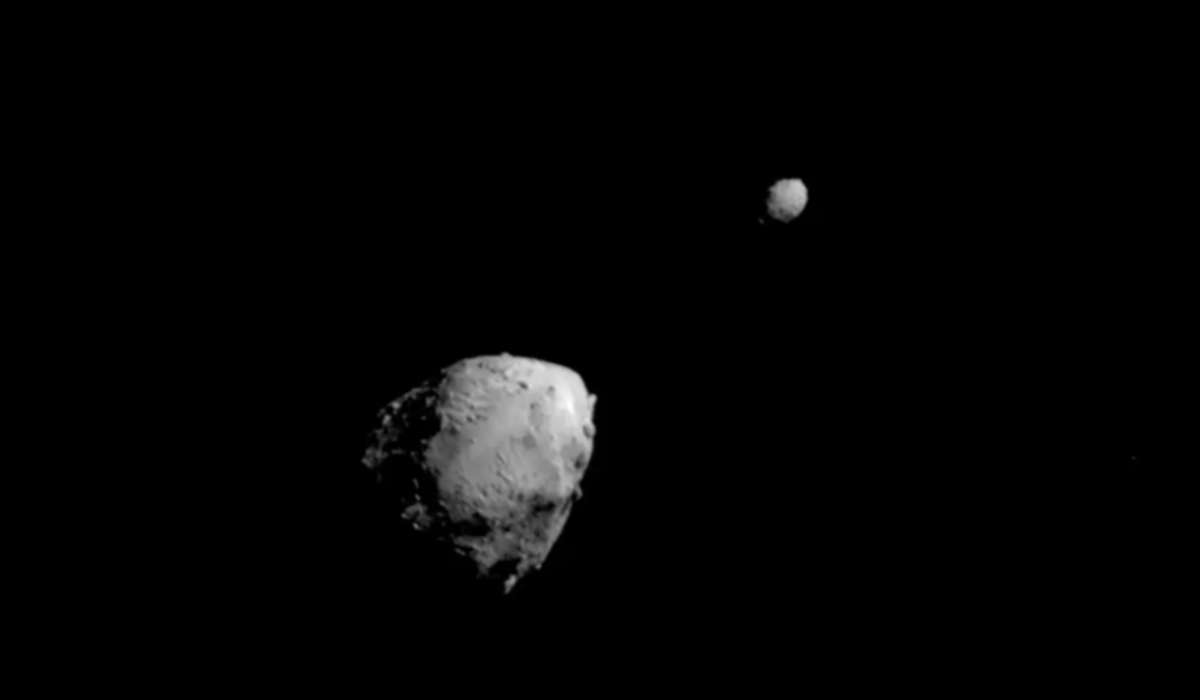
In order to protect us from such calamitous events, destroying an asteroid or changing its direction remains a real avenue to proceed. Scientists have considered the former option of breaking 2024 YR4 apart long before its threat was accurately calculated to be non-existent. The option of changing the direction of a body in space has already been pursued successfully with NASA’s DART mission.
More on Starlust
Asteroid previously projected to hit the Moon in 2032 will now miss, says NASA
New astonishing images from DART asteroid impact reveal shocking force of debris plume