Jupiter has more oxygen than the Sun, new study finds
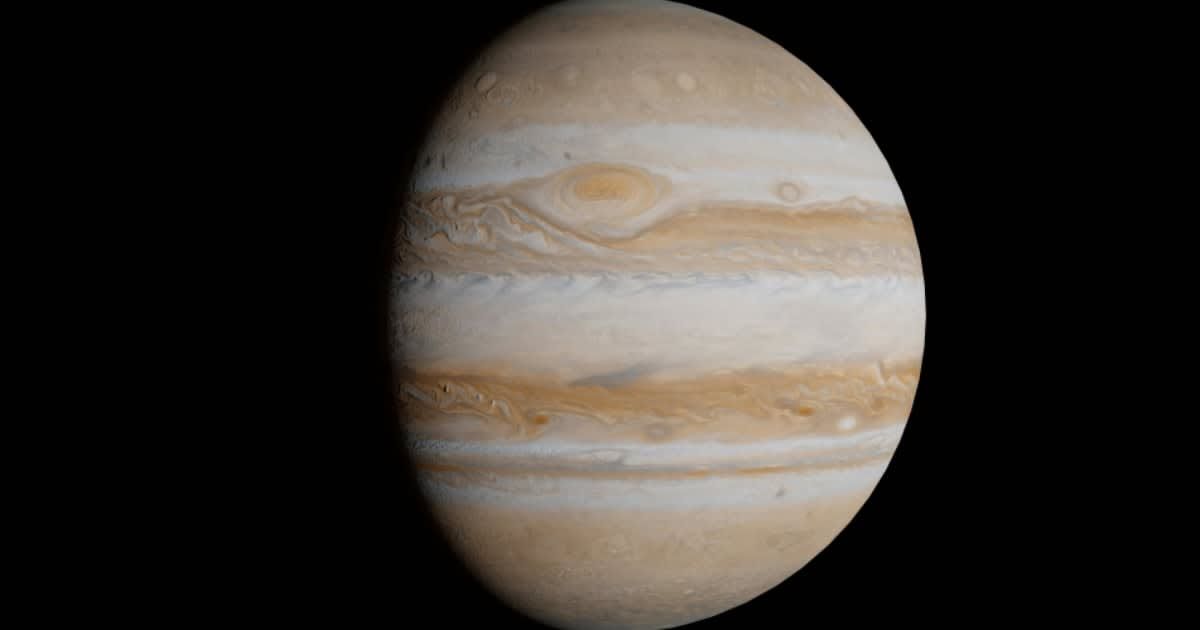
Jupiter’s striped appearance and its atmospheric clouds have been a source of fascination to scientists for many years. However, certain aspects of its make-up are still only recently being discovered, largely because no spacecraft has been able to make it through the dense clouds. Thanks to a new study courtesy of a team of scientists from the University of Chicago and Jet Propulsion Lab, the understanding of the composition of Jupiter has now been furthered. The study offers insights about how its constituent matter interacts within its depths and about the surprising amount of oxygen it holds.

This latter revelation, derived from the findings of the simulatio,n shows that despite being much smaller than the Sun, Jupiter holds between 1 and 1.5 times the amount of oxygen that it does. Jeehyun Yang, a postdoctoral scholar in the Department of Astronomy and Astrophysics at the University of Chicago, led the way to finding this breakthrough. “This is a long-standing debate in planetary studies,” Yang said in a statement. "It’s a testament to how the latest generation of computational models can transform our understanding of other planets."

Yang was referring to the disagreements over how much water and thus oxygen Jupiter might have. After all, the chemistry is not easy to grasp, with atmospheric molecules travelling between deeper, warmer layers and those high above, which are cooler. Not to mention, these molecules also undergo varied reactions to rearrange themselves. But these processes alone don't provide the full picture. The behavior of clouds and water droplets also needs to be considered. So Yang and his team incorporated both chemistry and hydrodynamics in the model they used for their study, published in The Planetary Science Journal. "You need both," Yang said. "Chemistry is important, but doesn't include water droplets or cloud behavior. Hydrodynamics alone simplifies chemistry too much. So, it's important to bring them together."

To be able to quantify the amount of oxygen present in Jupiter is huge, as it promises major insights into the formation of our solar system. After all, the Sun is made up of the same stuff as the planets that revolve around it. Understanding our solar system and its planets better can, in turn, aid us in our search for habitable worlds beyond it. Besides revealing how much oxygen Jupiter has, Yang's model also showed that the atmospheric circulation within the gas planet proceeds at a much slower pace than previously suspected. “Our model suggests the diffusion would have to be 35 to 40 times slower compared to what the standard assumption has been,” said Yang. One atmospheric molecule, for instance, would need multiple weeks instead of hours to travel between layers. “It really shows how much we still have to learn about planets, even in our own solar system,” Yang added.
More on Starlust
Jupiter’s moon Europa may lack geological spark needed for life, new study finds