3I/ATLAS's anti-tail pointing toward the Sun may be created by a swarm of objects, says Harvard astronomer

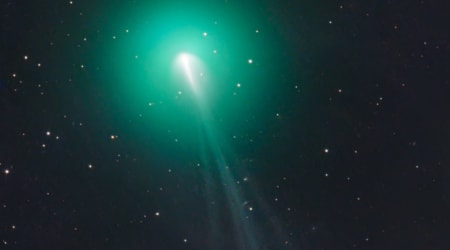
In the recent images of comet 3I/ATLAS taken in November, the interstellar object showed a “teardrop-shaped” coma with a faint but persistent extension pointing toward the sun. This development of the existence of an “anti-tail” was unusual because it was unlike already widely known comet tail dynamics, where a comet tail would point away from the sun. In his latest blog, Harvard astronomer Avi Loeb proposes an intriguing hypothesis: this anti-tail, rather than being gas or dust, might be comprised of a “swarm of objects” travelling with the comet.
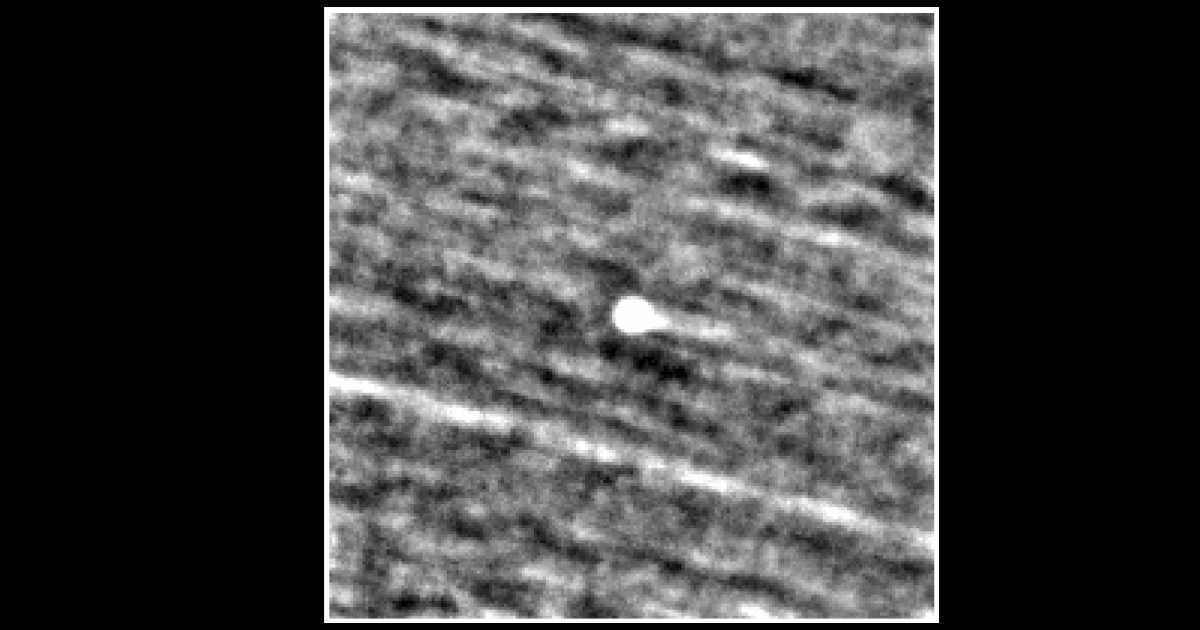
His hypothesis follows the reasoning that this tail stretches tens of thousands of miles and is bright enough to show up in stacked telescopic images. A general astronomical explanation for this phenomenon could be that it is a part of a natural process of the travelling comet, perhaps dust being blown in a particular direction from uneven heating. However, Loeb disagrees.

He argues that the strange glow is far more probable if the comet is being followed by a cloud of small solid fragments, possibly trillions of pieces. He suggests that as the comet heats up, it emits gas from the surface, creating a measurable “push,” similar to how steam escaping from a kettle would push it slightly. However, if solid fragments surround the comet, they would not be affected by these gas emissions.
They would continue to move due to the force of gravity alone. If the comet is being pushed outward but the fragments are not, this difference in motion appears as a visible separation when observed from a telescope. This separation could appear as pointing toward the Sun, creating an observable sunward glow.
☄️3I/ATLAS exhibits one of the strangest anomalies in recent years.
— 3I/ATLAS TV (@3iatlas_tv) December 2, 2025
According to JPL Horizons, it has a non-gravitational acceleration that behaves exactly like solar gravity — it weakens with 1/r², meaning the ratio between the two remains constant.
➡️ It makes it look as if…
According to Loeb, “[a] large swarm of objects would have a much larger surface area than that of 3I/ATLAS, even if the total mass in them is a small fraction of the mass of 3I/ATLAS.” This would mean that these objects would reflect far more sunlight than the comet itself, making the swarm appear brighter even if they weigh far less than the comet. In a study published on arXiv in October, the findings observed that the comet’s anti-tail is predominantly comprised of carbon dioxide (CO2), along with water (H2O).

The ratio of CO2/H2O of the tail is much higher than that of most known comets. Observations from SPHEREx and other facilities, such as the Neil Gehrels Swift Observatory, also detected strong water-ice absorption, a large extended CO2 coma, and active water hydroxyl (OH) emission, indicating active water outgassing. This water outgassing was present even when the comet was still many astronomical units away from the Sun.

These observations already indicated that 3I/ATLAS is physically and chemically active. However, its composition and patterns differ from the behaviors generally shown by other comets. They not only challenge generally known patterns of a comet but also open space for more controversial interpretations, like the one presented by astronomer Avi Loeb. This raises a pertinent question: Does this development mean that the object is artificial? Loeb does not mention so, but leaves space for the possibility that the object may not be natural.
🚨"3I/ATLAS shows a 16.16-hour brightness pulse with variations of tens of percent.
— 3I/ATLAS TV (@3iatlas_tv) November 30, 2025
This makes no sense if it’s just the nucleus rotating — most of the light comes from the coma, and the nucleus is far too small to cause such a big change."
More in the article below.👇…
The next few weeks will be crucial, with the comet fast approaching Earth on December 19, 2025. This will be the best chance for astronomers to take high-resolution images of the interstellar visitor. If Loeb’s Swarm theory turns out to be accurate, then we might see that a) the sunward glow is moving independently of the comet, b) the tail breaks into smaller parts, c) the patterns of the brightness changes, and/or d) the feature vanishes altogether. Any of these proposed behaviors can confirm or contradict astronomer Loeb’s Swarm hypothesis.
More on Starlust
Interstellar comet 3I/ATLAS to make its closest approach to Earth soon—where is it now?
Astronomers capture the 'best-yet color image' of interstellar comet 3I/ATLAS
Harvard astronomer Avi Loeb criticizes NASA’s big 3I/ATLAS reveal: 'Boring messages'