The first Chinese astronauts to visit the Moon could land at this 'high-priority' spot
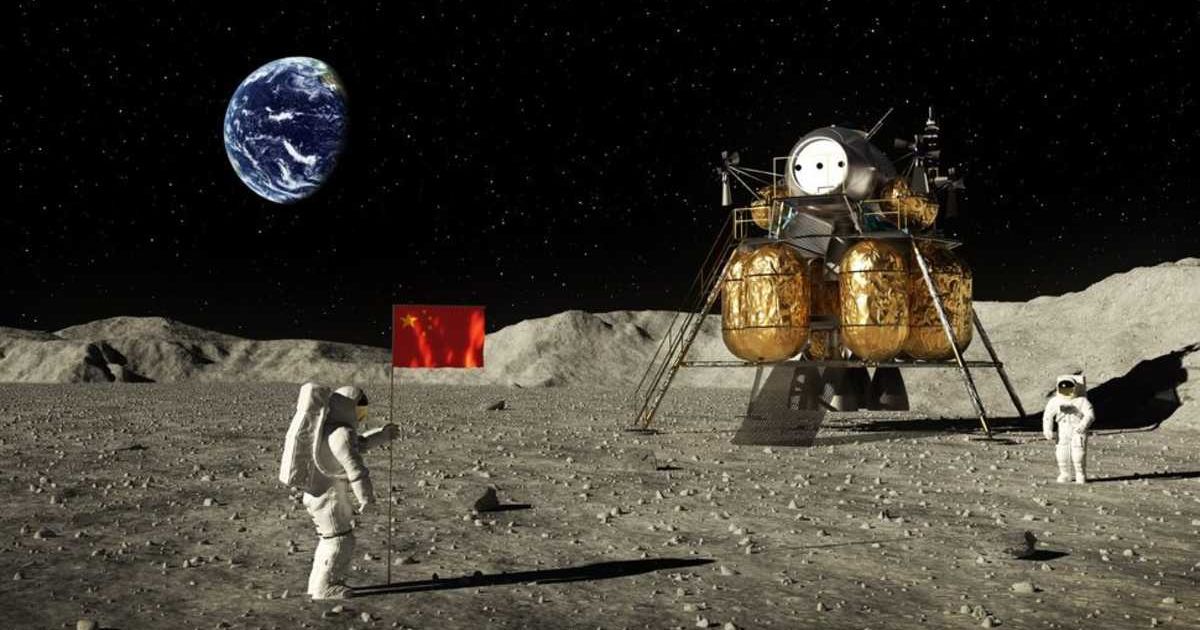
It's no secret that China wants to put its astronauts on the Moon by 2030. And now, it looks like it may have found the perfect landing for its first crewed lunar mission. Jun Huang, a professor at the China University of Geosciences, Wuhan, and his team looked into the Rima Bode region on the Moon, providing fresh insights into the logistics of the mission that would not just be historic for the country, but could unlock exciting information about the Moon’s history. The findings were published in the journal Nature Astronomy.

There is a lot that goes into choosing the right landing site. For starters, it should be located on the near side of the Moon, should be more or less even in terms of terrain, should get enough sunlight, and should offer access to features that are of interest to scientists. The initial list, consisting of 106 potential landing sites, was shortened to 14, of which Rimae Bode, located near the Sinus Aestuum, just north of the Moon's equator, is one. Huang and his team studied the region using data from U.S., Chinese, Indian, and Japanese lunar missions, along with archival observations from the ground-based Arecibo radio telescope, before identifying it as a high-priority landing spot.

“Rimae Bode is a high-priority ‘sweet spot,’” says Jun Huang, a planetary geologist at the China University of Geosciences in Wuhan and co-author of the new study, according to Scientific American. “Think of it as a prime piece of lunar real estate: its location near the equator provides much flatter, safer terrain for landing, along with constant sunlight for power [during the lunar day] and a direct line of sight to Earth for easy communication.”

As far as the scientific value of the region is concerned, Huang and his team have identified five features of interest, of which Sinus Aestuum is one. The other four are two basaltic regions of Rimae Bode proper, a dark layer of volcanic ash, and the surrounding highlands. The ash layer, the researchers think, erupted from the Moon's mantle billions of years ago and thus could offer insights into lunar history.

“The most groundbreaking discovery from the Rimae Bode region would likely come from the dark mantle deposits, which consist of volcanic ash and glass beads that were violently erupted from the moon's deep interior billions of years ago," Huang told Space.com. "These samples act as 'messengers' from the lunar mantle, offering a rare opportunity to directly analyze the chemical composition of the moon's deep heart—information that is usually hidden beneath miles of crust."

Huang added that to make the most out of the landing, astronauts selected for the mission must undergo rigorous geological training so that they are able to tell scientifically valuable materials apart from relatively ordinary ones. As of now, there is no further update as to what the next steps would be in the selection of the landing spot. China is, however, expected to launch a dedicated lunar remote-sensing satellite to obtain further data. Moreover, later this year, the Mengzhou spacecraft could hitch a ride on the Long March 10A rocket for its first orbital flight.
More on Starlust
NASA selects United Launch Alliance to provide upper stage for Artemis IV and V
NASA to send supplies to ISS with Northrop Grumman CRS-24; CRS-23 to undock this week