Mysterious iron 'bar' spotted inside the iconic Ring Nebula
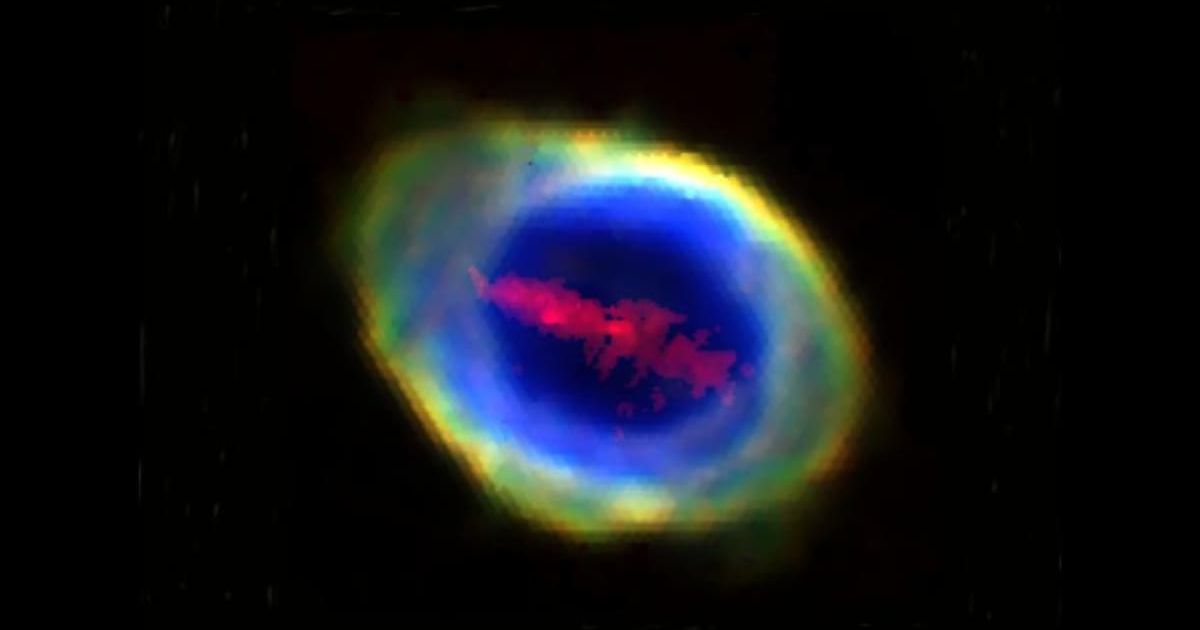
A team of astronomers from Cardiff University and University College London (UCL) has discovered a mysterious iron 'bar' inside the iconic Ring Nebula, located around 2,600 light-years away from Earth and shaped like a distorted doughnut. The researchers spotted the iron cloud using the Large Integral Field Unit (LIFU) mode of the WHT Enhanced Area Velocity Explorer (WEAVE) installed on the Isaac Newton Group’s William Herschel Telescope and reported their findings in a paper published in the Monthly Notices of the Royal Astronomical Society.
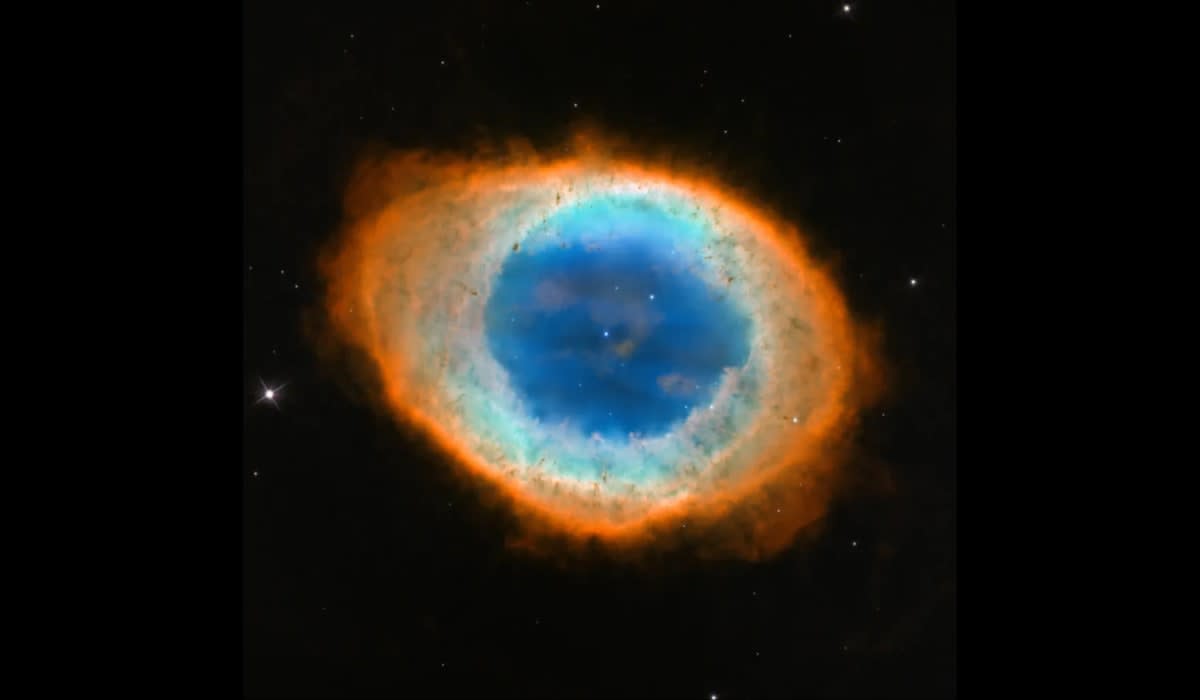
Planetary nebulae such as the Ring Nebula are born from Sun-like stars that shed their outer cores as they run out of nuclear fuel. The ejections from planetary nebulae are a huge source of the universe's carbon and nitrogen, which are key building blocks of life here on our planet. French astronomer Charles Messier first detected the Ring Nebula in 1779 in the constellation Lyra. However, despite many observational studies since then, it had never been captured this way. What lead author Dr. Roger Wesson, who's based jointly at UCL's Department of Physics & Astronomy and Cardiff University, and his team achieved is the most detailed observation of the Ring Nebula yet. "Even though the Ring Nebula has been studied using many different telescopes and instruments, WEAVE has allowed us to observe it in a new way, providing so much more detail than before," he said in a statement.
A bundle of hundreds of optical fibers, the LIFU made it possible for the researchers to capture the entire face of the nebula at all optical wavelengths. "By obtaining a spectrum continuously across the whole nebula, we can create images of the nebula at any wavelength and determine its chemical composition at any position," Wesson explained. The researchers have found that the mass of iron atoms in the bar is comparable to the mass of Mars, and its length is 500 times the orbit of Pluto around the Sun. "When we processed the data and scrolled through the images, one thing popped out as clear as anything – this previously unknown ‘bar’ of ionized iron atoms, in the middle of the familiar and iconic ring," Wesson added.
But the authors still don’t know how the iron bar formed. More detailed observations are needed to reveal what is happening out there, they say. They guess that there could be two potential processes. One is that the iron bar may contain clues as to how the nebula ejection went about. The other is that it might be an arc of plasma that came to be because a rocky planet was collateral damage of the star's expansion. “We definitely need to know more – particularly whether any other chemical elements co-exist with the newly-detected iron, as this would probably tell us the right class of model to pursue. Right now, we are missing this important information,” explained co-author Professor Janet Drew of UCL.
More on Starlust
Astronomers unveil stunning first image of rare dead star that had two massive explosions
Astronomers using JWST discover an ancient supernova from the first billion years of the universe