Interstellar comet 3I/ATLAS is full of alcohol, ALMA observations suggest
The interstellar comet holds more alcohol than almost all known comets in the solar system.
UPDATED 1 HOUR AGO
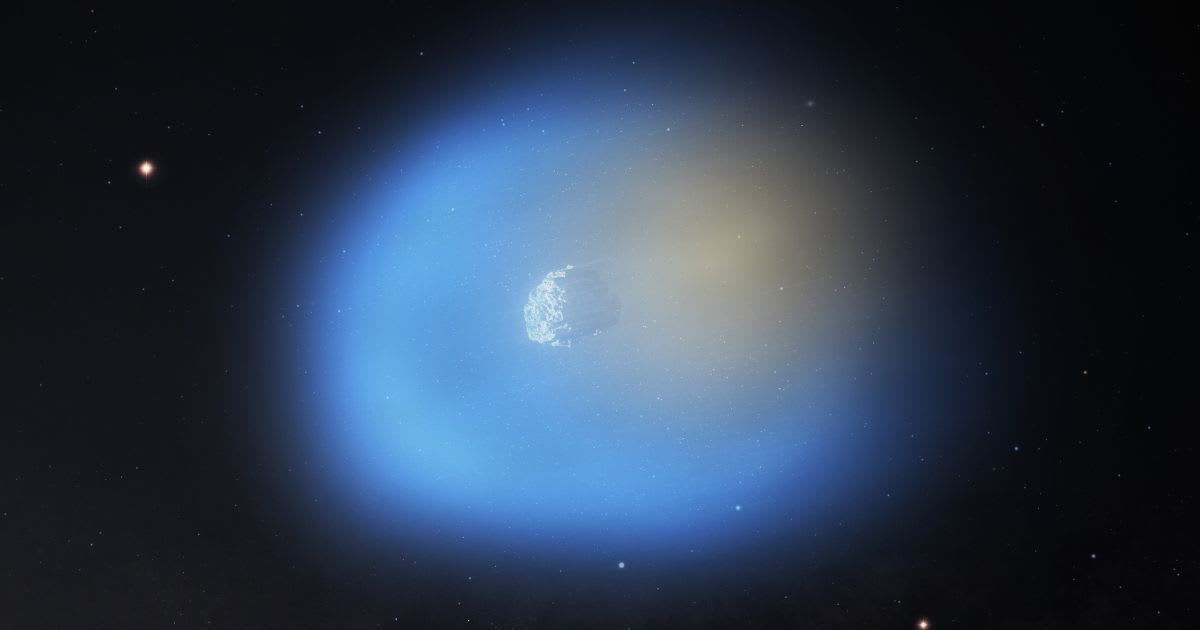
Artist’s impression of 3I/ATLAS passing near the Sun. Methanol gas (blue) with icy dust appears on the sunlit side, while hydrogen cyanide (orange) is shown on the dark side. (Representative Cover Image Source: NSF/AUI/NSF NRAO/M. Weiss)

Researchers have discovered that the interstellar comet 3I/ATLAS is packed with an unusually high amount of methanol. In fact, it’s said to hold more methanol than almost all known comets in our own solar system. The observations were made using the Atacama Large Millimeter/submillimeter Array (ALMA) in Chile, and the findings from the same have been posted on the arXiv preprint server.

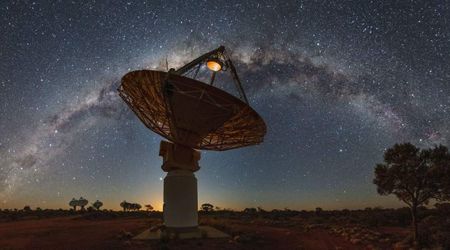
Like a celestial blanket the Milky Way forms an arc high above the antennas of the Atacama Large Millimeter/submillimeter Array (Image Source: ALMA Observatory)
Like a celestial blanket the Milky Way forms an arc high above the antennas of the Atacama Large Millimeter/submillimeter Array (Representative Image Source: ALMA Observatory)

In late 2025, 3I/ATLAS approached the Sun, whose rays warmed the interstellar comet’s icy surface. This led to a release of gas and dust, which formed the glowing coma. This coma’s chemical signatures hold the key to studying the comet’s composition, as well as discovering more about the solar system from which 3I/ATLAS came, without actually having to go all the way there. “Observing 3I/ATLAS is like taking a fingerprint from another solar system,” said the study’s lead author, Nathan Roth, a professor at American University, in a statement. "The details reveal what it’s made of, and it’s bursting with methanol in a way we just don't usually see in comets in our own solar system."
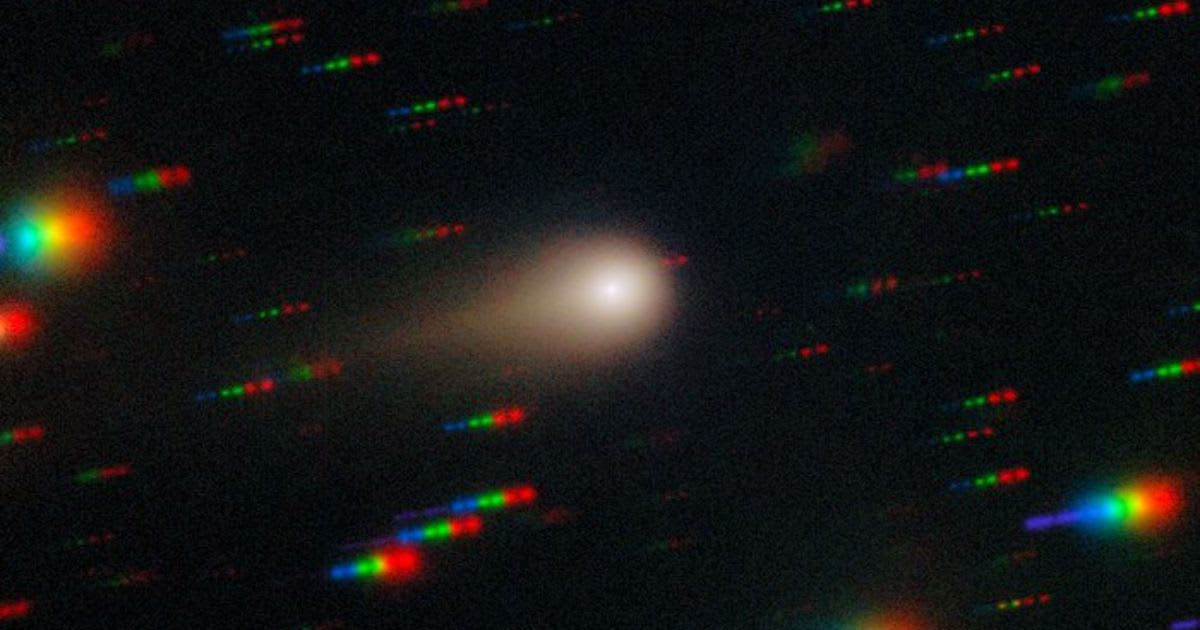
Comet 3I/ATLAS streaks across a dense star field in this image captured by the Gemini Multi-Object Spectrograph (GMOS) on Gemini South at Cerro Pachón in Chile (Image Source: International Gemini Observatory/NOIRLab)

There were two specific molecules in the coma that caught the attention of the researchers. They detected faint submillimeter signals from methanol (CH₃OH) and hydrogen cyanide (HCN). While the latter, nitrogen-bearing organic compound is more commonly seen in comets, 3I/ATLAS had far more methanol than hydrogen cyanide. And since the observations were made on two dates, the methanol-to-HCN ratios differed too. It was 70 on one instance and 120 on another. These staggering values make 3I/ATLAS among the most methanol-rich comets ever studied.
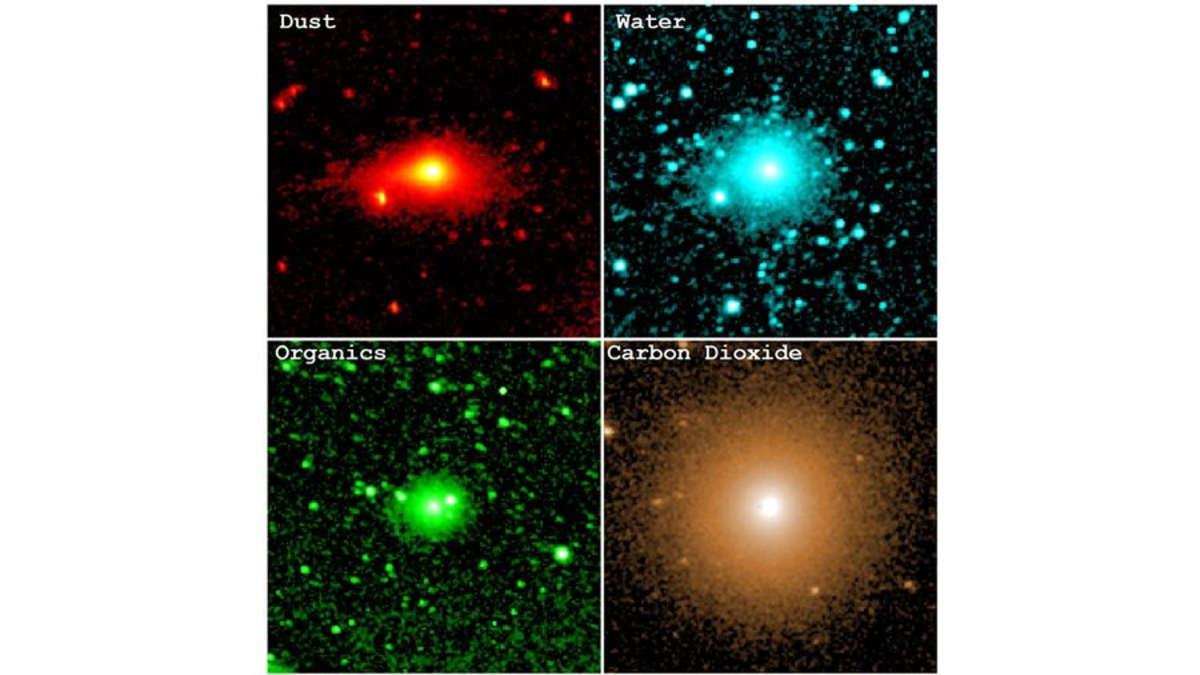
These observations by NASA’s SPHEREx show the infrared light emitted by the dust, water, organic molecules, and carbon dioxide contained within comet 3I/ATLAS’s coma during the mission’s December 2025 campaign. (Image Source: NASA)

The chemical makeup of 3I/ATLAS shows how different the interstellar comet is from the ones in our solar system. The latest ALMA findings also add to the earlier observations, such as those made by the James Webb Space Telescope (JWST), which found the comet’s coma to be dominated by carbon dioxide when it was far away from the Sun. In December 2025, NASA’s SPHEREx mission used its infrared instruments to observe 3I/ATLAS, and it had also detected methanol in addition to cyanide and methane.
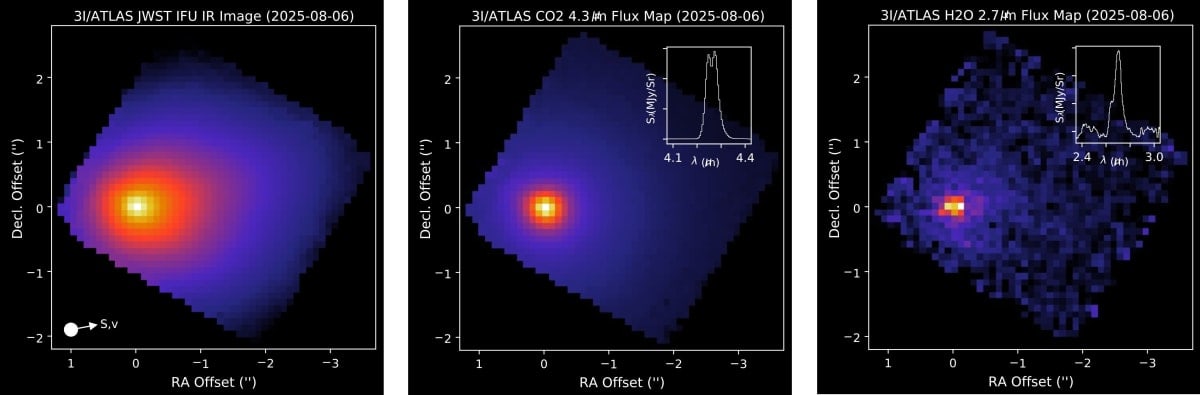
NASA’s James Webb Space Telescope observed interstellar comet 3I/ATLAS Aug. 6, with its Near-Infrared Spectrograph instrument (Image Source: NASA/James Webb Space Telescope)

Apart from just detecting methanol and HCN, the researchers also used the ALMA’s high-res imaging to observe how the gases behaved while they were escaping the comet. Like most solar system comets, HCN seemed to come directly from the nucleus, while methanol came from both the nucleus as well as from ice particles in the coma, which act like mini-comets. This behavior is common in some solar system comets, but this is the first time detailed observations of outgassing in an interstellar object have been made. 3I/ATLAS is only the third known interstellar object to enter our solar system. Astronomers would need to study more objects of the kind to expand their understanding of distant planetary systems.

More on Starlust

ESA's Juice captured interstellar comet 3I/ATLAS shortly after perihelion—here's what it found

Could we possibly catch up with 3I/ATLAS? A daring new plan says 'yes'
MORE STORIES

As per a new study, Dyson spheres around faint stars in the galaxy could offer new techno-signatures clues.
1 day ago
A new study has estimated the universe’s possible age by using precise data on stars.
1 day ago
Astronomers have sifted through half a petabyte of data to create a detailed 3D map.
5 days ago
The inner three stars are so tightly packed that they would fit inside the orbit of Mercury.
5 days ago
A strange fading radio signal hints at powerful gamma-ray burst or an elusive black hole.
7 days ago
The Jupiter-bound spacecraft got 120+ images that reveal jets, dust streams, and a glowing coma.
7 days ago
The planetary system TOI-2076 can help astronomers understand how planets change between birth and adulthood.
Mar 2, 2026
Supermassive black hole binaries where the black holes are separated by short distances are extremely hard to find.
Feb 26, 2026
The Karl G. Jansky Very Large Array in New Mexico and the MeerKAT radio telescope in South Africa were employed for the project.
Feb 26, 2026