Glowing 'jellyfish' cloud appears over Florida skies after SpaceX Starlink launch
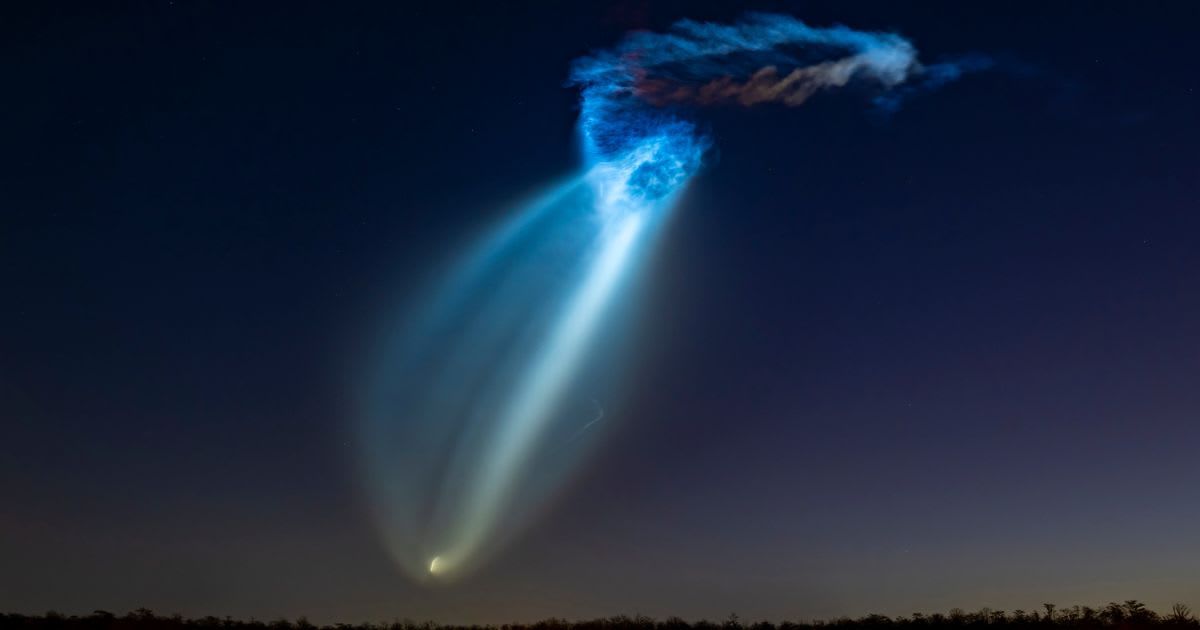
Following an early morning SpaceX launch, a glowing jellyfish-like cloud hovered in the skies of Tampa Bay, Central Florida, on Wednesday. The glowing plume appeared after a Falcon 9 rocket launched from Space Launch Complex-40 at Cape Canaveral Space Force Station. According to SpaceX, the rocket was carrying 29 Starlink satellites into low Earth orbit as part of the Starlink 10-40 mission.
Falcon 9 launches 29 @Starlink satellites from Florida pic.twitter.com/GMLUDFBTao
— SpaceX (@SpaceX) March 4, 2026
The glowing plume is nothing but the rocket’s exhaust taking shape in the predawn sky. When the exhaust plume from the rocket expands high in the atmosphere, it creates this large glowing shape. Yet, the formation is visible only at select times like sunrise or sunset, when the ground below is still dark, and there is just enough sunlight for this plume to glow. It takes different shapes, like jellyfish, spirals, regular clouds, or, in this case, a heart-like shape as well, before it dissipates. Residents and photographers along Florida’s Space Coast managed to get some stunning images of this fleeting formation.
Timelapse of this mornings SpaceX 10-40 jellyfish. @SpaceflightNow pic.twitter.com/D7yZex510n
— Pete Carstens (@CarstensPete) March 4, 2026
According to 10 Tampa Bay meteorologist Courteney Jacobazzi, the glowing plume is related to noctilucent-style cloud effects caused by the exhaust of the Falcon 9 rocket. "The higher up in the atmosphere you go, the colder it gets," she explained. "And of course, naturally, temperatures get sub-freezing as high as that rocket goes." Since the air up there is not just colder but also much thinner, the trail from the rocket expands, drifts freely, and takes different and ever-changing shapes. Moreover, given the Falcon 9’s 5:52 a.m. ET launch time that morning, the Sun was still below the horizon, and its early rays reflected off the exhaust against a darker sky.
JELLYFISH CLOUD! New pictures coming in across Florida from the SpaceX launch this morning! It has this unique look because the rocket and the plume are high enough above Earth that it’s illuminated by sunlight, but down near the ground for us it's still dark before sunrise. pic.twitter.com/7QHAOXP5XG
— Matt Devitt (@MattDevittWX) March 4, 2026
The payload launched during the mission constituted the latest batch of satellites populating the ever-growing Starlink megaconstellation. In fact, the Starlink 10-40 mission marked SpaceX's 28th mission of the year out of the more than 600 launches in the history of the company. The launch also marked the 25th time the reusable Falcon 9 first-stage booster supporting the mission flew. It landed on SpaceX’s drone ship—A Shortfall of Gravitas—in the Atlantic Ocean at around the 8-minute, 20-second mark after launch.

Florida’s Space Coast is no stranger to rare visual phenomena like the jellyfish-shaped cloud illuminating its skies. In fact, calling it ‘rare’ might be a stretch since similar plumes have been seen during previous SpaceX launches as well. A recent example is from October 16, 2025, when another Starlink mission caused an identical sky display. These formations are mostly harmless and fleeting and make for a pleasing natural-science spectacle for space enthusiasts.
More on Starlust
Strange gigantic ring of red light spotted in the night sky over central Italy
Bright green fireball traveling close to 100,000 mph lights up sky above Michigan's Great Lakes