3I/ATLAS latest update: Where to watch the interstellar comet livestream on December 19
The object was first spotted on July 1, 2025, by the NASA-funded ATLAS survey telescope based in Rio Hurtado, Chile.
UPDATED 21 HOURS AGO
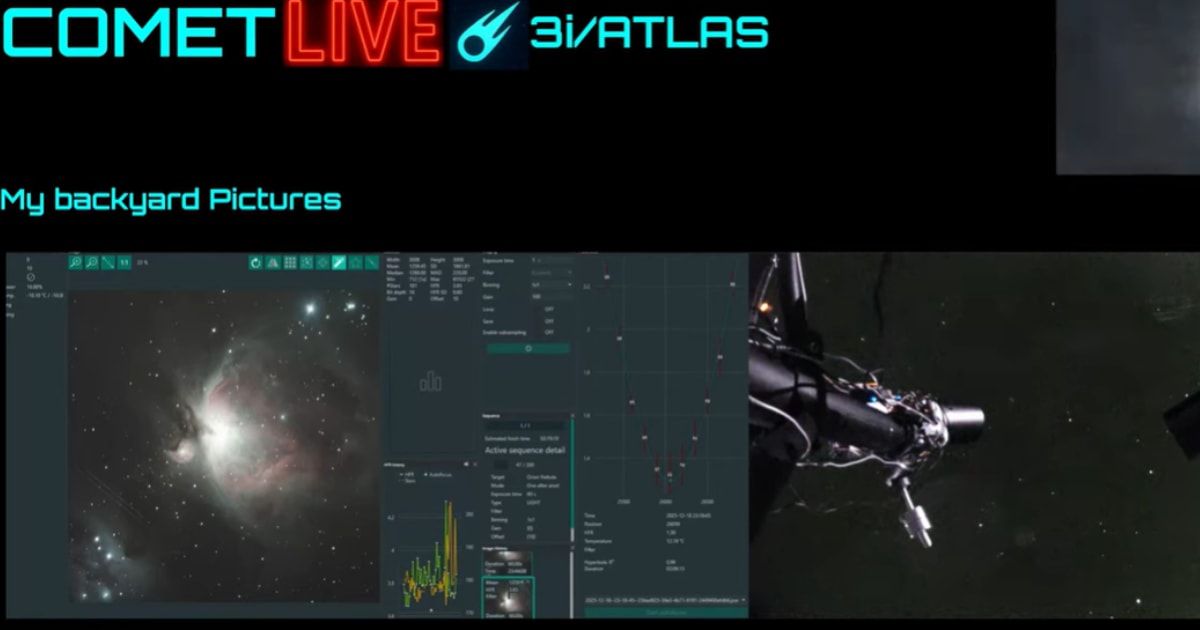
A screenshot of the Ray's Astrophotography YouTube page showing the countdown to the 3I/ATLAS livestreaming. (Cover Image Source: YouTube | Ray's Astrophotography )

The rare interstellar visitor, Comet 3I/ATLAS, is now making its closest pass to Earth. Only the third object of its kind ever detected, the comet is a priority for researchers, even though its huge distance (about 170 million miles) from Earth makes it invisible to the naked eye. To see it, skywatchers need a professional-grade telescope aimed toward the constellation Leo, just below the star Regulus, in the early morning hours. A dedicated live stream by Ray's Astrophotography, however, is offering a more accessible way to watch the comet. Unlike digital simulations, this broadcast offers viewers a raw, real-time feed of the interstellar visitor as seen through a telescope based in Texas.

Astronomers are convinced that 3I/ATLAS comes from a very distant part of the galaxy. Per them, it had to drift through the Milky Way for billions of years until it reached Earth from the direction of the Sagittarius constellation. Its status as an "outsider" was confirmed by experts who analyzed its hyperbolic trajectory and very high velocity, proving that it does not orbit our Sun. 
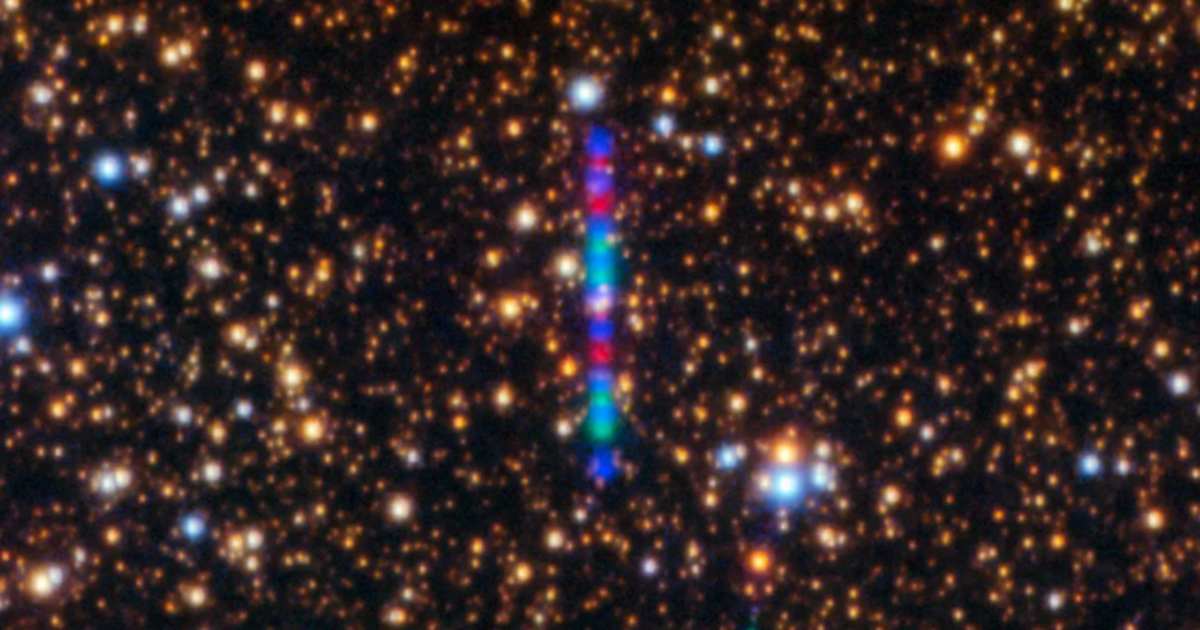
Interstellar comet 3I/ATLAS going past a dense star field  (Image credit: International Gemini Observatory/NOIRLab/NSF/AURA/K. Meech (IfA/U. Hawaii). Image processing: Jen Miller & Mahdi Zamani (NSF NOIRLab))
Interstellar comet 3I/ATLAS going past a dense star field (Image credit: International Gemini Observatory/NOIRLab/NSF/AURA/K. Meech (IfA/U. Hawaii). Image processing: Jen Miller & Mahdi Zamani (NSF NOIRLab))

3I/ATLAS is coming in at a far greater speed than average space rocks that form in our own neighborhood. When first discovered near the orbit of Jupiter, this comet was already cruising along at 137,000 mph, per NASA. As it swung inward around the Sun, the solar gravity served as a gigantic slingshot to accelerate the object to a maximum velocity of 153,000 mph. Now that this visitor has rounded the Sun, it is maintaining its extreme velocity as it travels out toward the outer reaches of the solar system.
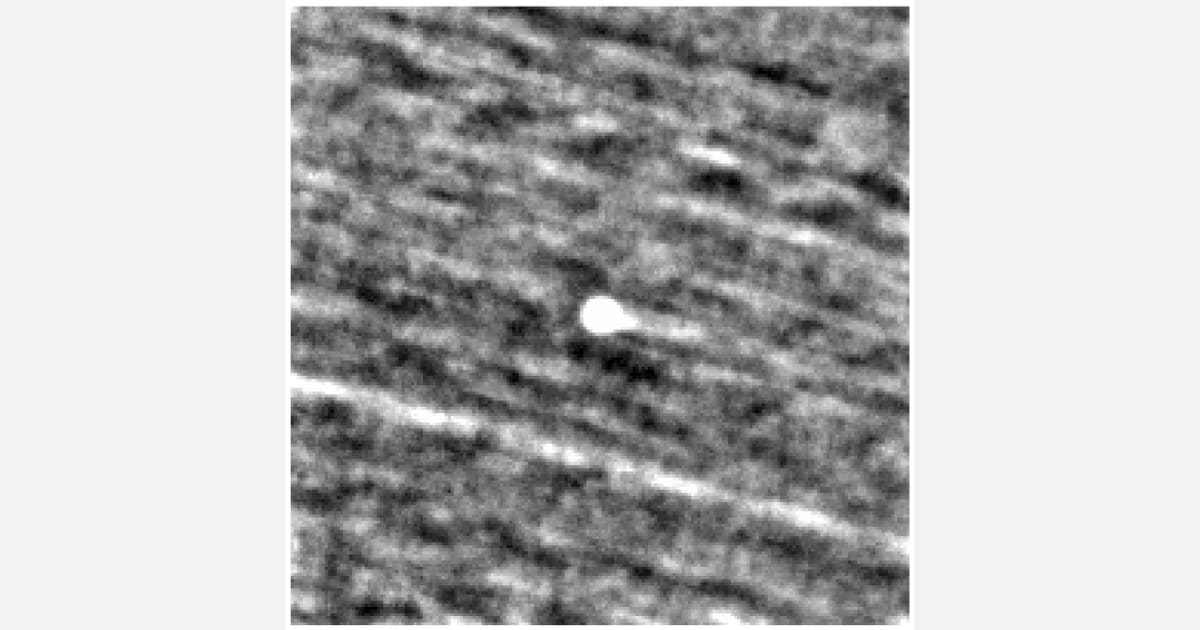
Comet 3I/ATLAS appears as a bright object near the center of this image, made from combining observations from NASA’s PUNCH mission taken from Sept. 20 to Oct. 3, 2025 (Image Source: NASA/Southwest Research Institute)

While the comet is now in retreat, it's not quite gone. Amateur backyard astronomers and professionals alike can still spot 3I/ATLAS with telescopes through the coming spring of 2026. But the viewing window is now starting to shut: each day, the object grows a little dimmer, a little farther away. Scientists are now racing to analyze the visitor before it's truly gone. NASA researchers are using a network of space-based and ground telescopes to study the chemical makeup of the comet to unlock secrets about the distant star system in which it was born, while the object is close enough to observe.

More on Starlust

Here are some quick facts about 3I/ATLAS ahead of its closest approach to Earth

Interstellar comet 3I/ATLAS's closest approach to Earth: Date, time and naked-eye visibility

Comet 3I/ATLAS makes its closest approach to Earth: Skywatching tips, livestream and more

 

MORE STORIES

Discovered in July by the ATLAS telescope in Chile, this comet is on a one-way trip through our solar system.
1 day ago
The object was first officially spotted on July 1, 2025, by the NASA-funded ATLAS survey telescope based in Rio Hurtado, Chile.
1 day ago
The closest approach of comet 3I/ATLAS to Earth will happen on Friday, 19 December 2025, at a distance of 1.798 Astronomical Units.
1 day ago
Now passing through the constellation Leo, the interstellar object sits at a distance so immense that the light from it takes about 15 minutes to reach us.
2 days ago
The interstellar comet 3I/ATLAS is currently visible in the constellation Leo, though its faint brightness of magnitude 12.5 means it is difficult to spot.
4 days ago
Observers will have ideal viewing conditions this year, as the New Moon guarantees zero moonlight interference.
5 days ago
The comet's closest approach to Earth will occur on Friday, December 19, 2025, when it will pass at a distance of approximately 167 million miles.
Dec 10, 2025
An event like this will not take place again before 2045.
Dec 9, 2025
Stargazers in both the Northern and Southern Hemispheres will be able to view the shower, though the display is typically superior from the North.
Dec 8, 2025
Not all of Saturn’s moons are visible in space; however, some can be bright enough to be traced by a reliable telescope from Earth.
Dec 8, 2025