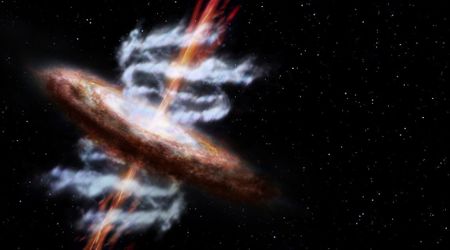
Baby stars don’t grow quietly—ALMA captures how a young star 'sneezes' rings of energy into space
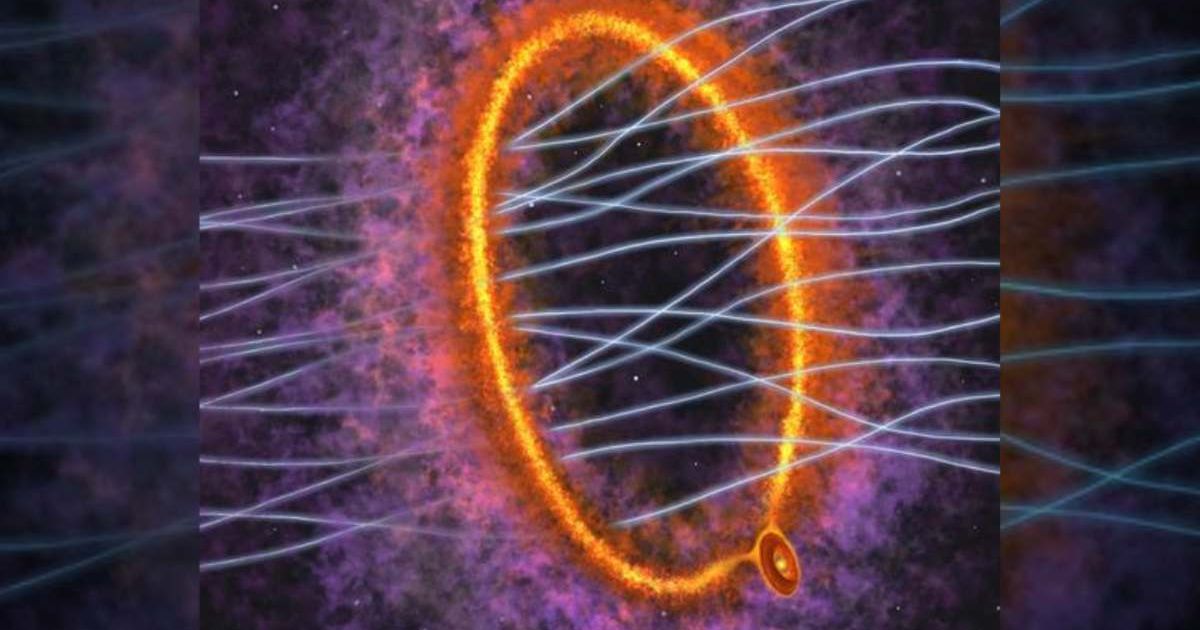
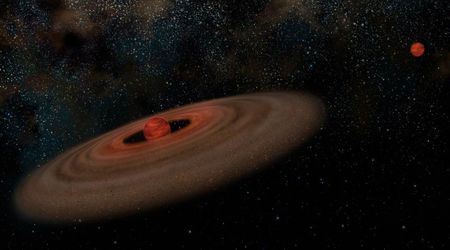
Astronomers at Kyushu University and Kagawa University have caught a glimpse of the early growth period of a baby star and the protostellar disk that surrounds it. The disk, made of dense gas and dust, is actually thrown away by the star. The gas and dust form a giant warm ring that occupies a space of about 1000 au (astronomical unit) around the star. The baby star also emits magnetic flux. These “sneezes” (outflows) of matter and magnetic energy aid the star in releasing excess energy, paving the way for proper star formation, the Japanese team describes in a study published in The Astrophysical Journal Letters.
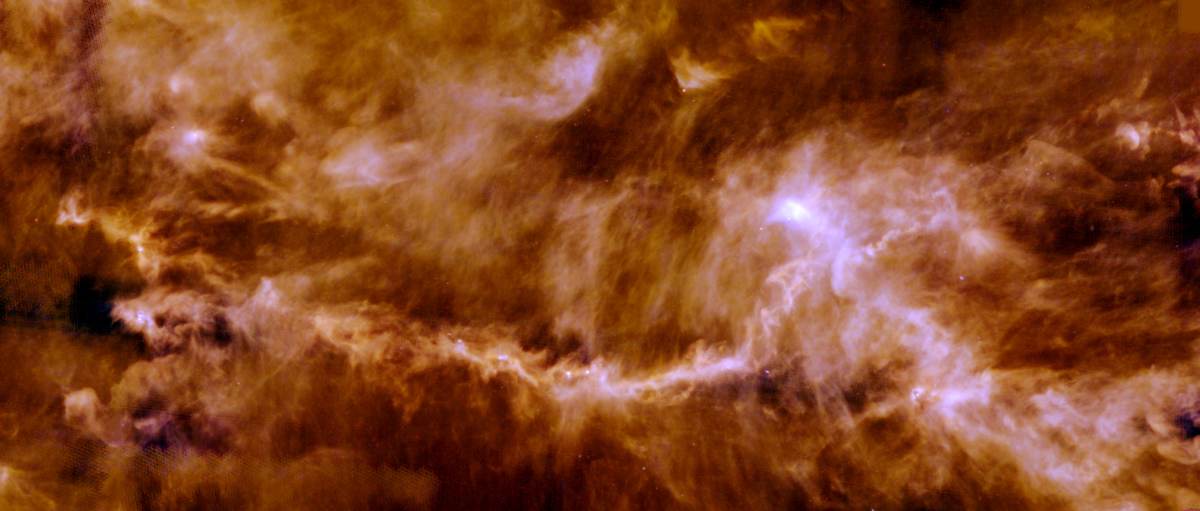
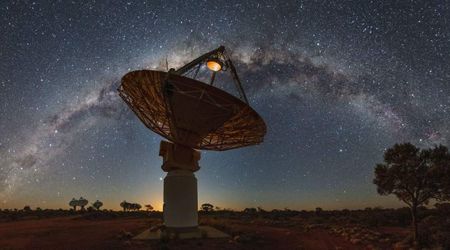
How stars like our Sun are born is still a mystery. However, existing knowledge shows that stars are born in stellar nurseries, where gas and dust clump together to spawn early stars called protostars. Keeping an eye on such nurseries may help us understand how stars are born. But gas and dust that envelop a growing star can obscure its light, making it difficult to observe a star’s birth process. However, sophisticated telescopes on Earth come to the rescue. “Thankfully, one of the most promising ways to get a clear view of protostars is to use the Atacama Large Millimeter/submillimeter Array (ALMA) in Chile,” explained lead researcher Professor Masahiro N. Machida of Kyushu University’s Faculty of Science, in a statement. “This radio telescope lets us see the different materials that make up stellar nurseries.”
Perched in the Atacama Desert in Chile, ALMA is an array of radio telescopes that wait for light signals from vast, cold clouds in space where new stars are forming. One such star-forming region is the Taurus Molecular Cloud. For a decade, the Japanese team has been tracking this cloud using ALMA. The Sun’s age is 4.6 billion years, whereas a newborn star is around 100,000 years old. The baby star that the researchers studied is younger than that. In a previous study, the team found a baby star with a spike-like structure spanning 10 au. The protostellar disk around the baby star formed such a structure, belching out matter and giving off excess energy. This finding led the researchers to focus on the molecular cloud core of MC 27 and to discover a much larger ring-shaped gas structure near the baby star.

“Our data showed that this ring is slightly warmer than its surroundings. We hypothesize that it is produced through a magnetic field threading the protostellar disk. In essence, the 'sneezes' we’ve observed in the past, but at a much bigger scale,” said first author Kazuki Tokuda from Kagawa University. “The warm ring we detected this time strengthens our hypothesis that baby stars undergo dynamic magnetic-gas redistribution shortly after birth, generating shock waves that warm the surrounding gas.” Next, the team plans to collect more information from high-resolution ALMA images to determine what lies inside the mammoth rings that surround the baby star. This will allow them to decode the underlying mechanism that leads to the formation of such rings. They also want to sift through data in the ALMA archive and locate other baby stars in different regions of the universe.
More on Starlust
Dusty galaxies from the universe's far edges show star formation had begun earlier than suspected