Astronomers witness the birth of a magnetar for the first time, confirming a 16-year-old theory
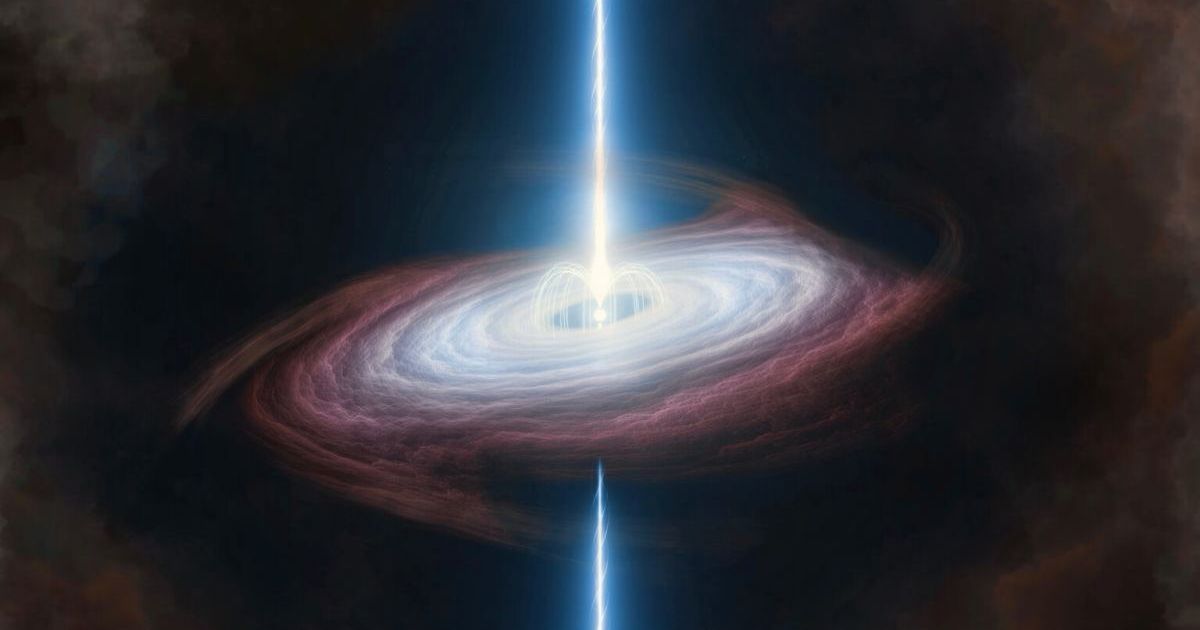
For the first time, a team of astronomers has caught a glimpse of a magnetar birth within the collapsing core of an extraordinarily bright supernova. Magnetars are a breed of neutron stars with an extremely powerful magnetic field. Research says the magnetar hurls charged particles into the debris of a supernova, contributing to its unparalleled brightness. The contribution of the newborn magnetar ejects energy into the expanding degree of explosion by hurling out streams of charged particles, helping power the supernova's brightness. This process also produces bumps on the supernova's surface. Each of the bumps is akin to a sound that gradually increases in frequency like a bird chirp, according to a study published in Nature. Such extraordinary explosions are known as superluminous supernovae, which are 10 times brighter than a typical supernova. They form when massive stars, nearly 25 times heavier than the Sun, end their life in an explosion, producing a long-lasting glow.

Since their discovery in the early 2000s, the source behind the extraordinary brightness of a superluminous supernova remained a mystery. In 2010, Dan Kasen, an astrophysicist at the University of California, Berkeley, first suspected and pointed out that a magnetar could power such a long-lasting glow. Not all massive stars end their life as black holes. Some collapse and compress their mass into a small sphere with a diameter of only about 10 miles across (20 kilometers approximately). A small fraction of these neutron stars become magnetars, possessing a magnetic field 100 to 1000 times stronger than that of a typical neutron star. When newly formed, a magnetar can spin more than 1,000 times per second. As a magnetar spins, its spinning magnetic field accelerates charged particles and flings them to the debris of an expanding supernova. This interaction enhances the brightness of the supernova.

In the latest study, lead author Joseph Farah of the University of California (UC), Santa Barbara, has analyzed data from a 2024 supernova named SN 2024afav and found evidence to confirm that a magnetar can power the extreme brightness of Type 1 superluminous supernovae (SLSNe-I). After the discovery, Farah heavily relied on Las Cumbres Observatory – a network of 27 telescopes around the world. Over more than 200 days, he monitored the supernova and measured changes in its brightness. Analysis of the data showed that the explosion occurred about a billion light-years away from Earth. Farah observed that the glow of the supernova, which peaked about 50 days after the explosion, didn’t dim like a typical supernova. Instead, its brightness slowly oscillated. The period of the oscillations gradually shortened, producing a series of four bumps which he compared to a sound gradually increasing in frequency, much like a bird chirp.
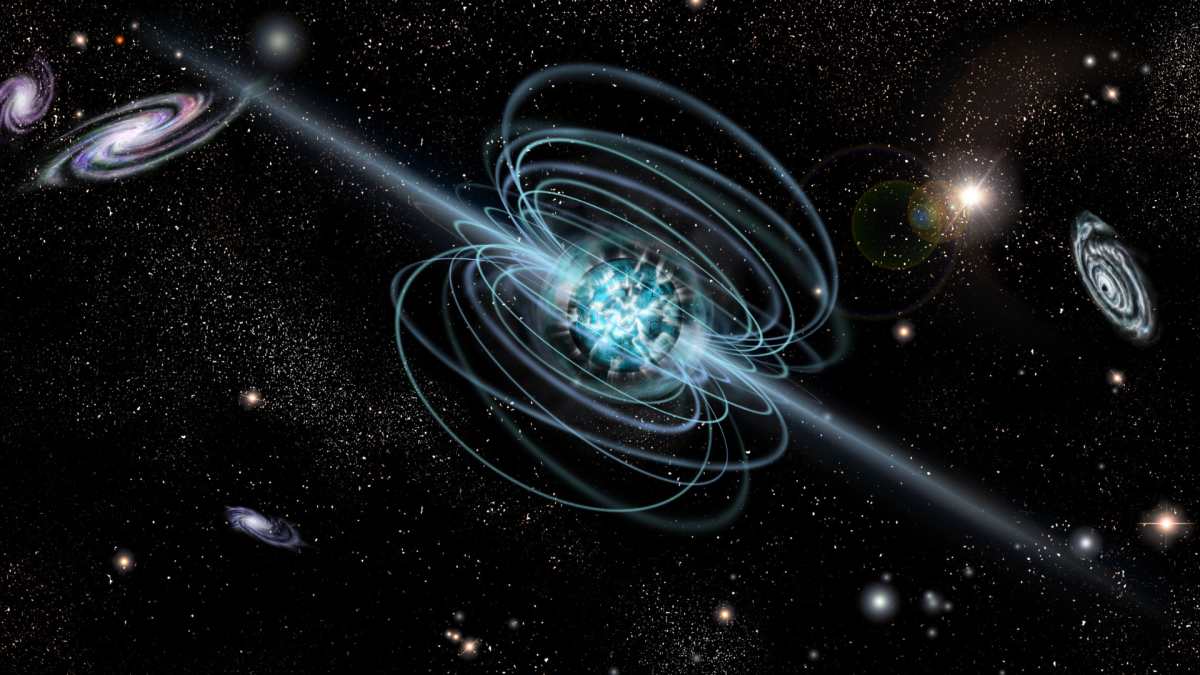
Previous superluminous supernovae exhibited one or two bumps, but none of them showed four distinct bumps. To better understand what goes on inside the magnetar and the supernova, Farah created a model of interaction between the magnetar and the surrounding supernova disk. The model suggests that some of the expanding material from the supernova falls back onto the magnetar, forming a disk of matter, also known as an accretion disk. As the disk is not perfectly symmetrical, its rotation axis can become misaligned with the magnetar's spin disk. “Because general relativity states that a spinning mass drags space-time with it, the spinning magnetar would produce an effect known as Lense-Thirring precession—that is, it would make the misaligned disk wobble,” according to a statement by UC Berkeley. “A wobbling disk could periodically block and reflect light from the magnetar, turning the whole system into a strobing cosmic lighthouse.” Gradually, it oscillates faster, causing light from the wobbling magnetar to fade away more rapidly. This creates the "chirp" as captured by the Earth-based telescopes.
"What's really exciting is that this is definitive evidence for a magnetar forming as the result of a superluminous supernova core collapse," said Alex Filippenko, a UC Berkeley distinguished professor of astronomy who is a co-author of the paper and one of Farah's soon-to-be mentors in the statement. "The basis of Dan Kasen and Stan Woosley's model is that all you need is the energy of the magnetar deep within and a good fraction of it will get absorbed, and that'll explain why the thing is superluminous.” “What had not been demonstrated was that a magnetar did, in fact, form in the middle of the supernova, and that's what Joseph's paper shows," Filippenko added.

Meanwhile, Farah prepares for his next venture. He gears up to discover more such "chirping supernovae" using the Vera C. Rubin Observatory that will come online shortly. "This is the most exciting thing I have ever had the privilege to be a part of. This is the science I dreamed of as a kid," Farah said. "It's the universe telling us out loud and in our face that we don't fully understand it yet, and challenging us to explain it."
More on Starlust
First-ever oval orbit detected in neutron star–black hole merger
Astronomers using JWST discover an ancient supernova from the first billion years of the universe