Today's Moon phase in New York
Discover today's Moon phase in New York with accurate details on illumination, visibility, and lunar events. Stay connected with the cosmos daily on Starlust.org
UPDATED 15 HOURS AGO
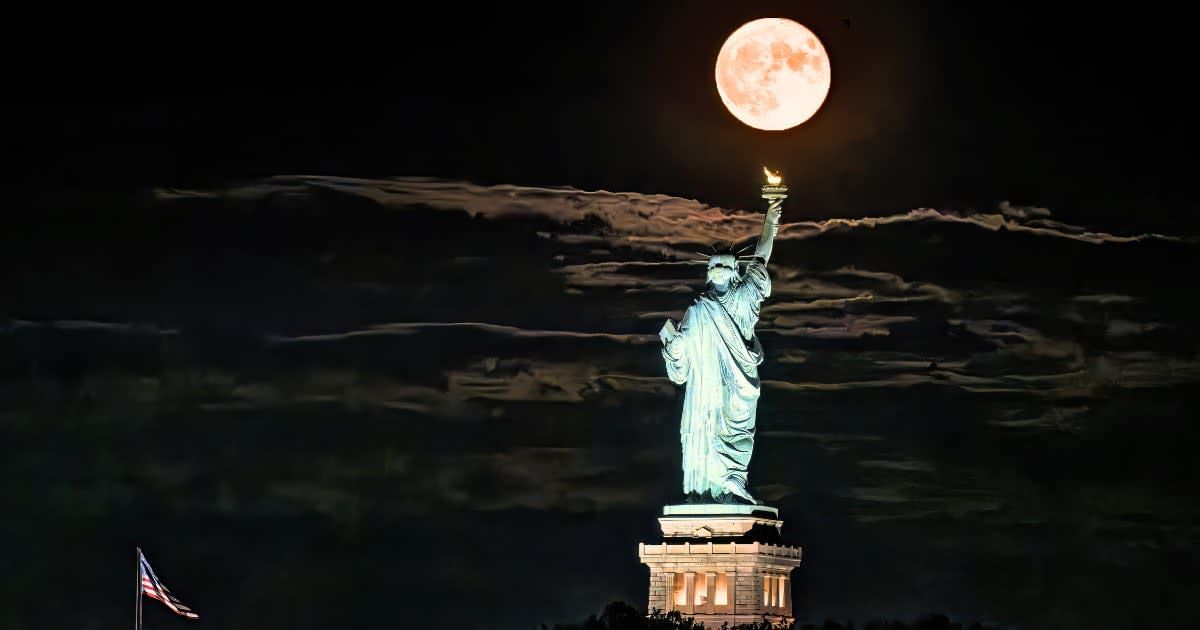
The Sturgeon Supermoon Full Moon breaks through the clouds above the Statue of Liberty in New York City. (Cover Image Source: Getty Images | Diana Robinson Photography)

Today's Moon phase in New York

Today’s lunar phase in New York is the Waning gibbous phase 🌕, with 60% illumination and an age of 20 days. The current distance between New York and the moon is 401008832 kms.

What is a Moon phase?

The Moon appears in different shapes each night, ranging from a fully illuminated disk to only a thin crescent of light. These observable lunar shapes that we see at different times of the month are called the Moon phases. They result from the changing perspective of the Moon as it orbits the Earth.

Types of Moon phases

There are mainly eight lunar phases that are displayed throughout the 29.5-day Moon cycle in the following order: New Moon, Waxing Crescent, First Quarter, Waxing Gibbous, Full Moon, Waning Gibbous, Third Quarter, and Waning Crescent. Read more about the Moon phases here.
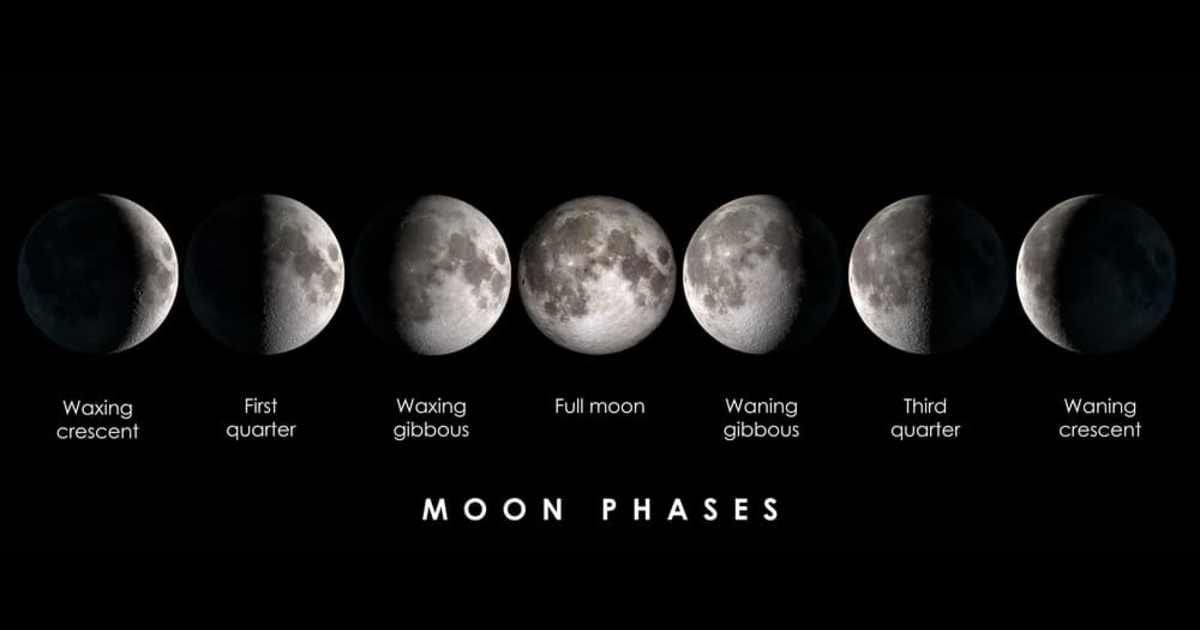
How Moon phases affect skywatching events

For skywatchers, tracking Moon phases becomes the key to planning the best viewing experience. For example, the Full Moon can actually make it difficult to spot dimmer celestial events in the night sky due to intense moonlight. On the other hand, during the New Moon, the absence of the moonlight creates a darker sky, making it an ideal time for observing deep-sky objects like galaxies or star clusters. Each phase offers unique opportunities - the Waxing Gibbous serves as the best time to spot the features on the lunar surface, whereas, during the Waxing Crescent Moon, stargazers often find it easier to observe planets such as Venus and Mars, as they shine brighter in the twilight sky.

What does the Moon look like today?
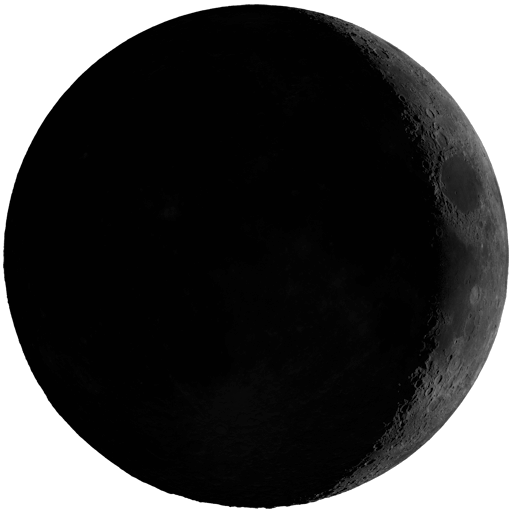
Waning gibbous
Waning gibbous

Sources:
https://moon.nasa.gov/moon-observation/daily-moon-guide/?intent=011
MORE STORIES

The comet will fly so close to the Sun during perihelion that it might get completely vaporized.
2 days ago
The Waning Gibbous Moon on February 6, 2026, offers views of a host of recognizable lunar features.
2 days ago
While it will be a breathtaking sight, very few people will actually be able to witness it.
4 days ago
With the wet dress rehearsal scheduled for Saturday, we may see the launch of Artemis II soon after the Snow Moon.
Jan 30, 2026
Wednesday night's sky brings us an early phase of the Moon in its monthly cycle.
Jan 21, 2026
With most solar storms traveling towards Earth at roughly 450 km/s, this one raced through space at around 1660 km/s.
Jan 20, 2026
Scientists use the term 'solar apex' for the direction our Sun and its planets are traveling in through the Milky Way.
Jan 15, 2026
On Tuesday, February 17, 2025, the comet is predicted to come closest to Earth at a distance of around 151.5 million kilometers, or 1.01 astronomical units (AU).
Jan 9, 2026
A geomagnetic storm watch is in effect for tonight, as the Sun has released high-speed streams and a couple of CMEs.
Jan 8, 2026
Skywatchers can look forward to a bright start to February with the Snow Moon reaching its peak, marking the second Full Moon of the year.
Jan 6, 2026