NASA's James Webb teams up with Hubble to image Saturn's atmosphere in unprecedented detail
![Complementary views of Saturn from NASA’s James Webb Space Telescope and Hubble Space Telescope. [Cover Image Source: NASA, ESA, CSA, STScI, Amy Simon (NASA-GSFC), Michael Wong (UC Berkeley); Image Processing: Joseph DePasquale (STScI)]](https://d3hedi16gruj5j.cloudfront.net/796852/uploads/88100f20-2912-11f1-9fd1-05487271e453_1200_630.jpeg)
Thanks to the combined efforts of the James Webb Space Telescope and the Hubble Space Telescope, we have the most detailed images ever of Saturn’s atmosphere. Both telescopes can capture sunlight reflected from the gas giant’s banded clouds and hazes. Hubble provided a snapshot of color variations across the planet. Webb’s infrared vision, on the other hand, revealed the composition of clouds and chemicals at different depths of the atmosphere, according to NASA. So, each telescope essentially tells a different part of the same story, helping researchers figure out how the gas giant's atmosphere works as a connected three-dimensional system. Images gathered by both telescopes support the previous observations made by NASA’s Cassini when it orbited the planet between 1997 and 2017.
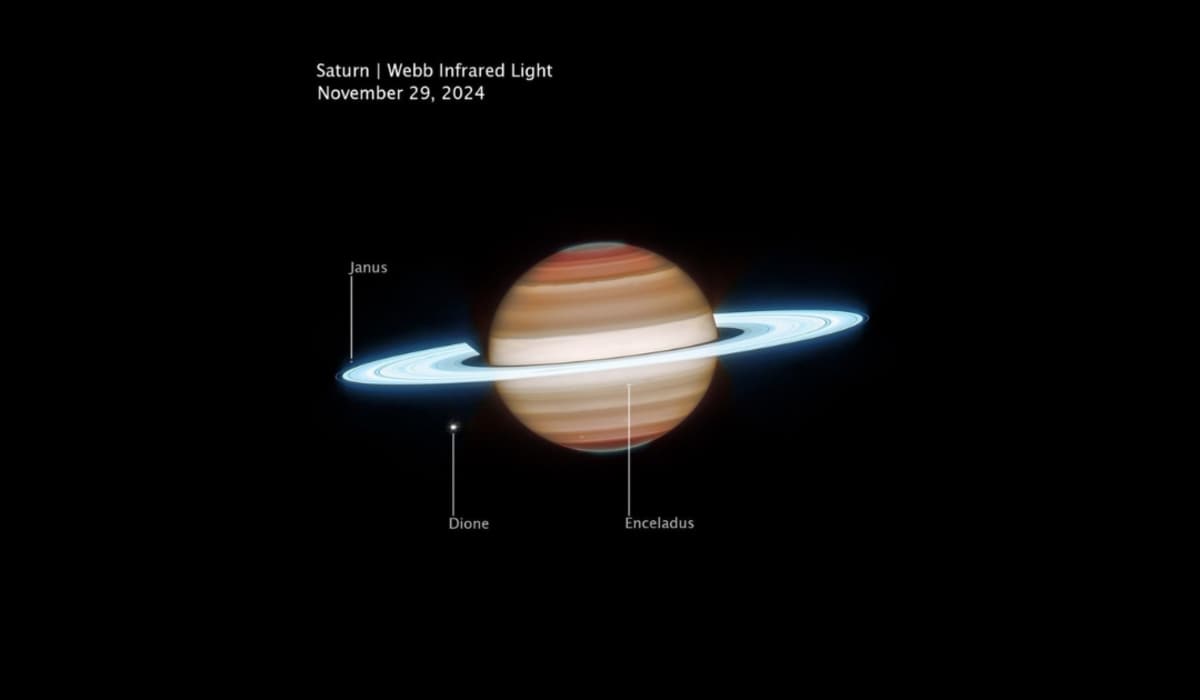
Hubble turned its gaze toward Saturn and began snapping it as a part of a program called OPAL (Outer Planet Atmospheres Legacy). This program started more than a decade ago, but the latest images were captured in August 2024. A few months later, Webb joined and imaged the planet’s clouds using Director’s Discretionary Time. The Webb images show a long-lived jet stream. This is known as the "ribbon wave" that passes across the northern mid-latitudes. Below it, a small spot hangs as a lingering relic of a “Great Springtime Storm" that raged between 2010 and 2012. Signs of other storms dot the southern hemisphere of Saturn, and they are also visible in the image.
![Visible light view of Saturn captured by NASA's Hubble on Aug. 22, 2024. [Image Source: NASA, ESA, STScI, Amy Simon (NASA-GSFC), Michael Wong (UC Berkeley); Image Processing: Joseph DePasquale (STScI)]](https://de40cj7fpezr7.cloudfront.net/56a0a3c0-e81e-4678-9dda-1ef0a3f8c2fa.png)
All these things are shaped by powerful winds and waves beneath the thick veil of clouds. This indicates that Saturn can act as a natural laboratory for studying fluid dynamics under extreme conditions. Saturn’s north pole has a hexagon-shaped jet stream whose pointed edges are visible in both images. First discovered in 1981 by NASA’s Voyager spacecraft, the jet stream is one of the most enigmatic weather patterns in the solar system. It also reveals the stability of atmospheric processes on giant planets. The hexagon jet will be visible until the 2040s. After this, Saturn’s north pole will plunge into darkness for 15 years.

Webb’s infrared vision captured stunning details of this planet’s poles, which emit grey-green light. Such light could come from a layer of aerosols in the upper atmosphere that scatters light differently at those latitudes. Auroral activity can also create such a glow as charged molecules strike the planet’s magnetic field, generating the observed color near the poles. Auroras are no strangers to Saturn, with both Hubble and Webb having already exposed such phenomena on the giant. Webb’s infrared image also shows Saturn’s iconic rings, which are made of highly reflective water ice, while both telescopes provide a glimpse of the sunlit face of the rings. Delicate ring features such as spokes and a thick central region in the B ring show up differently in the images of two observatories. The outermost ring, known as F, appears thin and crisp in the Webb image, but it glows only slightly in the Hubble image.

Saturn revolves around the Sun. Earth, too, moves in its orbit. These orbital motions change the viewing angle of Saturn’s face and ring. The 2024 observations, captured 14 weeks apart, show the giant planet moving from northern summer toward the 2025 equinox. It will slip into southern spring and later into southern summer in the 2030s, allowing Hubble and Webb to give us better views of this planet.
More on Starlust
Hubble Telescope accidentally captures comet C/2025 K1 (ATLAS) breaking up after perihelion
Mysterious 'Little Red Dots' found by James Webb Telescope may not be baby black holes after all