A tiny constellation is rising in the evening sky this week—here’s how to spot the galaxy hidden inside it

A tiny constellation is rising through the evening sky this week—inside which an entire galaxy is hidden. Triangulum, the 78th largest constellation out of 88 recognized ones, can be seen emerging in the eastern sky just after sunset from the northern hemisphere. M33, or the Triangulum Galaxy, is a spiral galaxy which is the third largest in our Local Group, located around 2.7 to 3 million light-years away from Earth. This means skywatchers would be looking at feeble light that was emitted by the galaxy millions of years ago.

Although Triangulum is a small constellation, it hosts an intriguing deep-sky body—M33—and this week is a good window for stargazers to catch a glimpse of the galaxy. M33 is visible through binoculars or a telescope in the night sky as it lies around a visual magnitude of 6. This is generally considered to be close to the limit of human vision under dark-sky conditions, such as a remote location with minimal or no light pollution.
The faint triangle that points to M33
In the night sky, Triangulum is visible as a barely perceptible triangular pattern, and the three prominent stars, Alpha Trianguli (Mothallah), Beta Trianguli (Alaybasan), and Gamma Trianguli (Apdu), can help stargazers find M33. This constellation is located between Perseus and Pisces, where these three stars make a triangular shape.
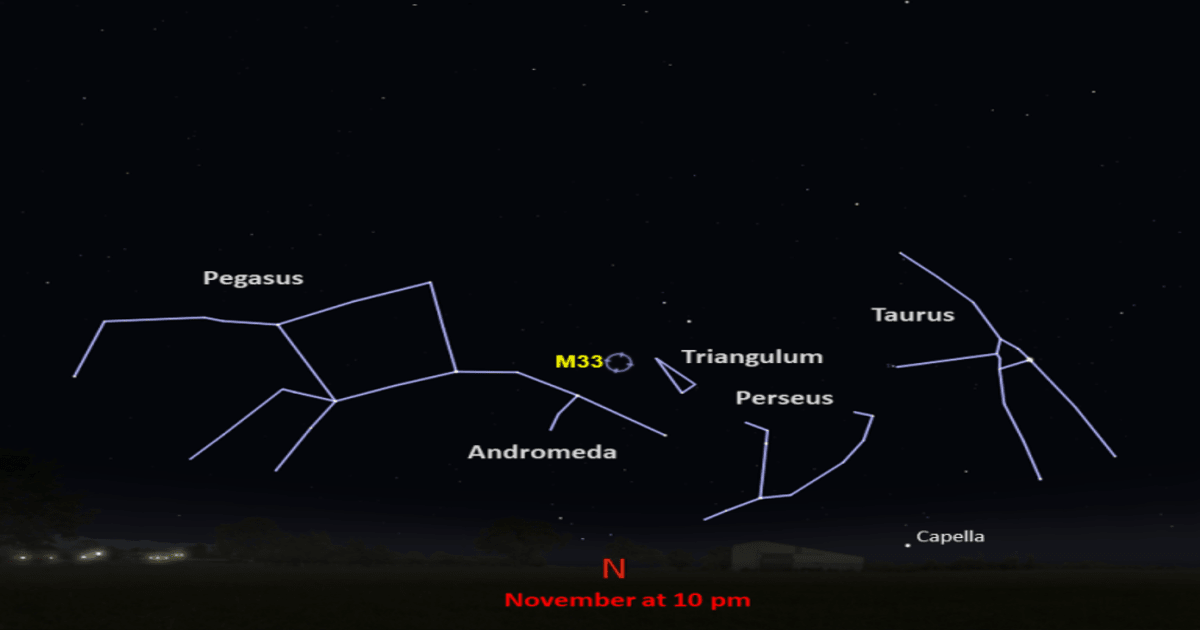
Among the trio, Beta Trianguli is the brightest, shining with a magnitude of around 3.0, making it moderately visible even in areas with mild light pollution. It is followed by Alpha at a magnitude of 3.4 and Gamma at 4.0, both dimmer than Beta in the night sky. There is also one more relatively bright star located to the northwest of Gamma Trianguli named Delta Trianguli. These stars together help to identify this triangular pattern.

Skywatchers can look towards the western side of this constellation and locate M33, which appears at a patch of faint light at around 4.3 degrees west-northwest of Alpha Trianguli. It can be difficult to spot, as its light is spread out over a relatively large area, but binoculars or a telescope can make it easier to find.
How to spot M33 in the evening sky this week
After sunset, Triangulum rises, and as the evening progresses, it moves higher in the night sky. During dawn hours, M33 sits at its highest point in the sky. For observers at mid-northern latitudes, it reaches about 25 degrees above the eastern horizon around 10 p.m. local time. This week will be pretty good for skywatching, with little to no moonlight to interfere with the views of some of the greatest celestial objects.
To observe M33, go to a location with dark skies and minimal light pollution. A pair of low-magnification, wide-field binoculars can be used to observe this galaxy. But if you want a closer look at its spiral structure, a telescope is suggested. For beginners, binoculars may be a better option to spot the faint glow of the galaxy before they switch to a telescope.
More on Starlust
Skywatching events in March 2026: Onset of spring and more
Constellations with the most visibility in January 2026: Easy viewing tips