 0:45
China launches its largest-ever resupply mission to Tiangong space station
China launched the Tianzhou-10 cargo spacecraft from the Wenchang Spacecraft Launch Site on May 11, 2026, to deliver a brand new spacesuit for Taikonauts, among other things, to the Tiangong space station. The launch went ahead successfully thanks to a Long March-7 carrier rocket, which lifted off from the launch site in Hainan Province at 8:14 a.m. on Monday (Beijing Time), according to Xinhua. Combined with the remaining supplies and hardware, the contents of the cargo craft constitute the largest payload of all resupply missions since the station’s construction began. Read full article on Starlust: https://starlust.org/china-launches-tianzhou-10-its-largest-resupply-mission-to-the-tiangong-space-station/
More Videos
 1:21
SpaceX's Super Heavy V3 completes full duration 33-engine static fire at full thrust
Ahead of the imminent Starship Flight 12, Super Heavy V3 successfully completed a full-duration, full-thrust static fire with all 33 Raptor engines at Starbase, Texas, on May 7, 2026.
 1:51
SpaceX Falcon 9 to crash into the Moon in August 2026
A 45-foot-tall piece of a Falcon 9 rocket launched in 2025 is now on a collision course with the Moon, set to strike the lunar surface at nearly seven times the speed of sound. But with no atmosphere and no nearby human sites, what actually happens when it hits? Here’s everything you need to know about the August 5 impact, the crater it could create, and why future Moon bases may make events like this far more important. Read the full article on Starlust: https://starlust.org/space-x-falcon-9-rocket-to-collide-with-moon-on-5-august-2026-impact-time-riskseverything-to-know/ Video edited with footage from SpaceX, Firefly Aerospace and Pixabay. Royalty Free Music from HookSounds. Thumbnail credit: Brandon Moser via Getty Images.
 0:35
NASA’s Curiosity rover spends 5 days 'shaking off' stuck Mars rock
On April 25, 2026, NASA’s Curiosity rover accidentally lifted and got a 13-kilogram Mars rock nicknamed “Atacama” stuck to its drill after collecting a sample. After five days of vibrations, drill spins, and robotic arm movements, the rock finally broke loose and shattered onto the Martian surface on May 1. Video edited with footage from NASA/JPL-Caltech. Royalty Free Music from HookSounds.
 1:35
One month later: reliving Artemis II’s historic lunar flyby
A month ago today, we watched history unfold live from NASA’s Orion spacecraft as the Artemis II crew flew around the Moon on what was easily the mission’s most unforgettable day. In just a matter of hours, spaceflight records were broken, tears were shed, the lunar far side was visited, and humanity got closer to the Moon than it had in over 50 years.
 2:59
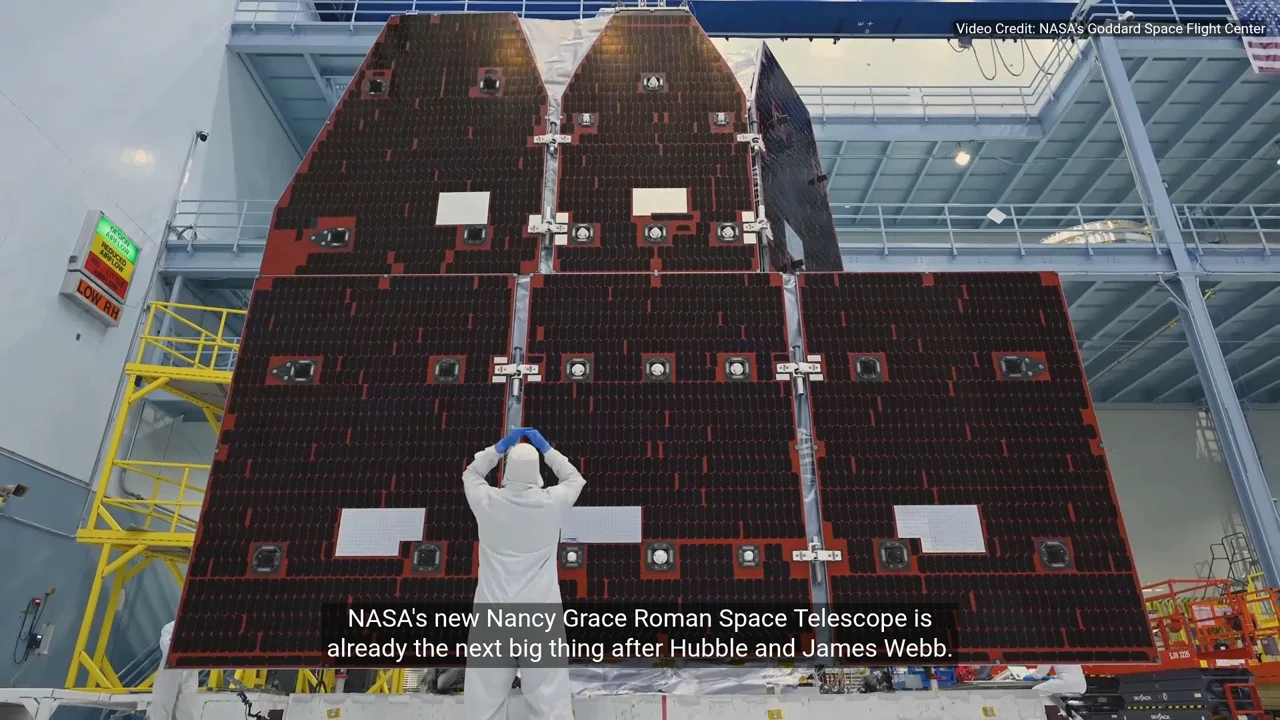
NASA’s new Nancy Grace Roman Space Telescope vs. Hubble and James Webb, explained
With the Roman Space Telescope now targeting launch as early as August 2026 — hinted by NASA Administrator Jared Isaacman during the recent budget hearings — here’s everything you need to know about the revolutionary new observatory and what sets it apart from icons like Hubble and James Webb.
 0:40
“There's nothing absolute": Christina Koch reminds us our world is fragile and is shaped by 'our' choices
#ArtemisII mission specialist Christina Koch pointed out that the sense of permanence we feel is an illusion. There’s a quiet shift that happens when you stop seeing the world as something fixed and start seeing it as something fragile. The ground beneath us, the sky above us, the stories we tell ourselves about permanence all seemed uncertain when Koch saw our world from the cosmic wilderness. She understood that nothing is promised, yet we can make everything possible. When the scale of our existence expands, so does our responsibility. So Koch noted how the world is not just where we live. It is rather what we shape, every day, with every choice. And maybe that’s the most powerful truth of all.
 0:40
Artemis II Pilot Victor Glover has the best reaction as U.N. Ambassador sings him ‘Happy Birthday’ on stage
On April 30, Artemis II Pilot Victor Glover turned 50. He spent part of the day at the United Nations Headquarters in New York, accompanied by his crew—Christina Koch, Reid Wiseman, and Jeremy Hansen. During the event, Mike Waltz, the United States Ambassador to the United Nations, playfully “embarrassed” Glover by breaking into a loud rendition of ‘Happy Birthday’ on stage. Glover’s reaction quickly became one of the most memorable moments of the roundtable event.
 0:20
"You put us in a small spaceship...and we became best friends for life": Artemis II astronaut Christina Koch
Sometimes, the people you work with end up becoming your closest friends—and the Artemis II crew proves it. After three years of training for this historic mission, they launched aboard the Orion spacecraft from Kennedy Space Center on April 1. Over the course of their nearly 10-day journey around the Moon, they experienced every high and low together—coming back not just as a team, but with a bond that’s built to last. Still images by NASA and Getty
 1:30
Artemis SLS rocket vs Apollo Saturn V rocket launches
Two historic Moon mission launches, nearly half a century apart — here’s NASA’s Space Launch System rocket and the Apollo-era Saturn V compared side by side at liftoff. Which one’s your favorite? Comment below! Disclaimer: Both videos are sourced from public footage available on NASA’s Image and Video Library.
 1:30
Artemis SLS rocket vs Apollo Saturn V rocket launches
Two historic Moon mission launches, nearly half a century apart — here’s NASA’s Space Launch System rocket and the Apollo-era Saturn V compared side by side at liftoff. Which one’s your favorite? Comment below! Both videos are sourced from public footage available on NASA’s Image and Video Library.
 0:15
President Trump shakes hands with the Artemis II crew at the Oval Office
As he concluded his meeting with the #ArtemisII crew at the Oval Office on 29 April, President Donald J. Trump made sure to shake hands with the astronauts as well as #NASA Administrator Jared Isaacman, thanking them for successfully carrying out the historic Moon mission.
 0:27
Trump's joke cracks up Artemis II commander Reid Wiseman
From one commander to another: Can you guess what President Trump said that left Reid Wiseman in splits? Comment below!