Artemis II crew all set to enter lunar flyby phase as Orion completes final prep
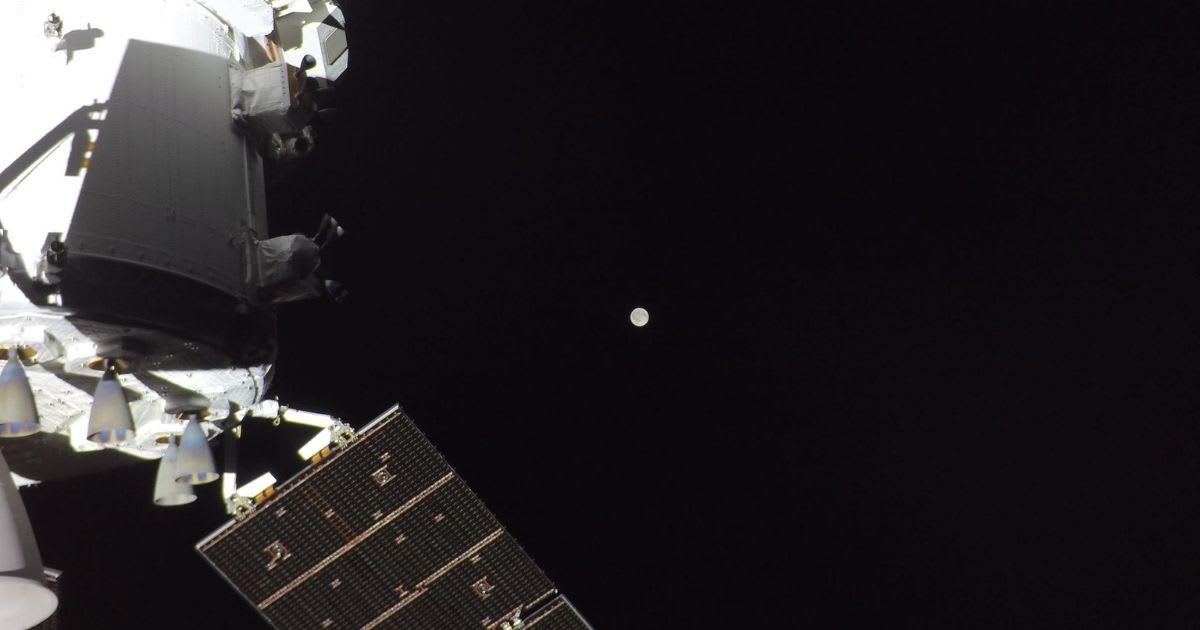
Artemis II is on the brink of history as the Orion spacecraft closes in on the Moon to complete one of the mission’s most important objectives. On its fifth day of flight, the crew is currently in the final phase of activities before its lunar flyby. According to NASA, Orion is expected to enter the Moon’s sphere of gravitational influence at 12:41 a.m. EDT on April 6. In preparation, the astronauts are now wrapping up a critical sequence of operations like trajectory adjustments, spacesuit testing and science targets review.

Testing the Orion Crew Survival System (OCSS) suits was a key step in this final prep phase before the flyby. These suits are designed to keep the astronauts safe during dynamic phases of flight. They provide life support in the event of cabin depressurization, and also support survival after splashdown. The Artemis II crew evaluated the OCSS suits by checking for leaks, simulating seat entry, testing mobility, and even eating and drinking while suited. These tests are crucial for both regular operations and emergency scenarios.
Successful outbound trajectory burn!
— NASA Artemis (@NASAArtemis) April 6, 2026
This means that the Orion spacecraft fired its thrusters to further fine-tune the astronauts' path to the Moon.
Coverage of the lunar flyby tomorrow begins at 1pm ET (1700 UTC). https://t.co/uC5tOnQeA1 pic.twitter.com/3yeGmXUomP
As Orion approaches the Moon, the crew needs to refine its trajectory through a maneuver called the outbound trajectory correction (OTC) burn. Initially, flight controllers had canceled two previous maneuvers since the spacecraft’s trajectory was precise and didn’t need correction. However, the OTC burn, scheduled for 10:03 p.m. EDT, has now been completed, as Mission Specialists Christina Koch and Jeremy Hansen reviewed the necessary procedures, with Hansen monitoring the spacecraft’s configuration and navigation data.
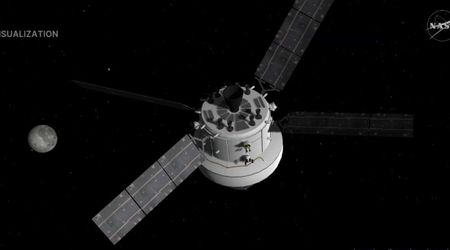
POV: You're flying by the Moon.
— NASA Solar System (@NASASolarSystem) April 5, 2026
This visualization is designed to show you what exactly the Artemis II astronauts will see outside their window during their lunar flyby.
Here, the seven-hour visualization is compressed into 28 seconds. ⬇ (1/4) pic.twitter.com/2OMAy37oht
A major goal of the Artemis II mission is to observe the Moon from a first-of-its-kind vantage point. Mission control has sent a final list of 30 science targets, and the crew will coordinate with ground teams to finalize their plan to observe these lunar areas. This includes the roughly 600-mile-wide Orientale Basin, which spans the near and far sides of the Moon, and is nearly 3.8 billion years old. The astronauts will be able to study Orientale’s features up close from multiple angles, as the crater would be bright and visible during the Orion flyby. Another key Artemis II science target is the Hertzsprung Basin, which is roughly 400 miles wide and is located on the Moon’s far side, northwest of Orientale. The ringed Hertzsprung is older and more degraded than even the ancient Orientale, and comparing these two will help understand how lunar surfaces evolve over geologic timescales.
Artemis astronauts, here’s your Moon-observing assignment 👀
— NASA Science (@NASAScience_) April 5, 2026
This custom science plan is fine-tuned for the exact lighting conditions on the Moon’s surface when the Artemis II crew flies by, and for their viewing angle as they’re hurtling through space. ️⬇ (1/5) pic.twitter.com/Il8SHjSG8d
NASA has released a timeline for the Artemis II flyby around the Moon (Monday, April 6):
- 12:41 a.m. EDT (04:41 UTC) — Orion enters lunar sphere of influence (41,072 miles from the Moon)
- 1:30 p.m. EDT (17:30 UTC) — Briefing on science goals from mission control
- 1:56 p.m. EDT (17:56 UTC) — Crew will surpass Apollo 13’s record of most distance traveled from Earth
- 2:45 p.m. EDT (18:45 UTC) — Lunar observations begin
- 6:44 p.m. EDT (22:44 UTC) — Temporary communications blackout (expected)
- 6:45 p.m. EDT (22:45 UTC) — “Earthset,” where Earth disappears behind the Moon
- 7:02 p.m. EDT (23:02 UTC) — Closest approach to the Moon: 4,070 miles above surface
- 7:07 p.m. EDT (23:07 UTC) — Maximum distance from Earth: 252,760 miles
- 7:25 p.m. EDT (23:25 UTC) — “Earthrise,” communications restored
- 8:35–9:32 p.m. EDT (00:35–01:32 UTC, April 7) — Solar eclipse visible from Orion
- 9:20 p.m. EDT (01:20 UTC, April 7) — Lunar observations conclude
Finally, at 1:25 p.m. EDT (17:25 UTC) on Tuesday, April 7, Orion is expected to exit the lunar sphere of influence at 41,072 miles from the Moon. As mentioned in the timeline, NASA expects to lose comms for about 40 minutes as the Moon would block radio signals when Orion passes behind it. Additionally, the timeline is expected to mark Apollo's crewed mission distance record being broken and extended by approximately 4,000 miles within a span of just a few hours. Live coverage of NASA’s Artemis II lunar flyby will begin at 1 p.m. EDT (17:00 UTC) on NASA+, YouTube, Amazon Prime, Apple TV, Hulu, Netflix, HBO Max and Roku.
More on Starlust
Artemis II: NASA working to resolve 'burning smell' reported by crew and issues venting wastewater
'There is nothing normal about this': Artemis II astronauts get candid as they head for the Moon