 1:45
NASA confirms cause of mysterious boom heard across the Northeastern U.S. on May 30
NASA and NOAA data helped scientists quickly solve the mystery behind a powerful boom heard across the northeastern U.S. on May 30. The culprit was a meteor that exploded high above the Boston region, creating a shockwave heard across multiple states. Radar data suggests meteorites may have survived the blast and fallen into Cape Cod Bay, turning a brief atmospheric event into a potentially recoverable meteorite fall. Read full article on Starlust: https://starlust.org/like-300-tons-of-tnt-meteor-explosion-over-u-s-rattles-residents/ Representative footage courtesy of Getty Images / Pexels / Pixabay.
More Videos
 1:08
How does a Moon Base help NASA’s future missions to Mars?
During a Moon Base event on March 26 at NASA Headquarters in Washington, Administrator Jared Isaacman explained how the agency’s long-term lunar strategy could help humanity eventually reach Mars. Building on the Artemis program, NASA plans to develop a permanent Moon Base and lunar outpost capable of supporting astronauts for extended missions on the Moon’s surface. This future Moon mission architecture is designed to test the habitats, technologies, life-support systems, and deep space operations needed before sending humans to Mars. From astronaut training to sustainable lunar infrastructure, the Moon is becoming NASA’s proving ground for the next era of space exploration.
 2:34
SpaceX Starship V3 maiden test flight
The massive Starship V3 rocket lifted off from Pad 2 of SpaceX Starbase to validate its all-new hardware. Made up of Starship V3 spacecraft and the Super Heavy booster, the Raptor engines ignited at 6:30 pm EDT on May 22, 2026. This flight was vital for NASA's Moon Base and Artemis plans, not to mention for SpaceX's own ambitions.
 1:55
Administrator Jared Isaacman breaks down NASA’s three-phase Moon Base plan
Administrator Jared Isaacman just outlined NASA’s three-part plan to build a permanent Moon base. From Blue Origin’s privately funded lunar lander mission to massive cargo deliveries and international science payloads, each mission is designed to prepare for long-term human life on the Moon. The missions will test everything from astronaut mobility and autonomous operations to how lunar infrastructure can survive the Moon’s extreme environment. According to Isaacman, these are only the beginning of a much larger effort to return to the Moon and stay there for good.
 0:27
Big update: NASA targets Moon Base II and III launches before the end of 2026
NASA plans to deliver cargo to the lunar surface using Astrobotic’s Griffin lander under the second Moon Base mission, while the third mission will carry payloads selected through an open competition along with contributions from international partners. Both lunar missions are currently targeted for launch before the end of 2026.
 0:53
NASA explains why astronauts are returning to the Moon despite harsh conditions
“The Moon is as beautiful as it is hostile.” NASA Chief Jared Isaacman explains why the space agency still wants humans to return to one of the harshest environments in space, where temperatures swing from over 250°F to below -400°F, with no atmosphere, radiation protection, or shelter from meteorites.
 0:55
Neil deGrasse Tyson on how our universe may connect to a multiverse
Astrophysicist and cosmologist Neil deGrasse Tyson, speaking with journalist Robert Krulwich during 92Y's Giants of Science series in 2007, explored one of cosmology’s biggest questions: How did the universe begin? Tyson discussed the idea that our universe may be just one “bubble” within a far larger multiverse, where countless universes could emerge and vanish over time. But this raises an even deeper mystery: if our universe had a beginning, what created the multiverse itself? According to Tyson, one possible answer is as fascinating as it is unsettling: the multiverse may have always existed. Video courtesy: The 92nd Street Y, New York
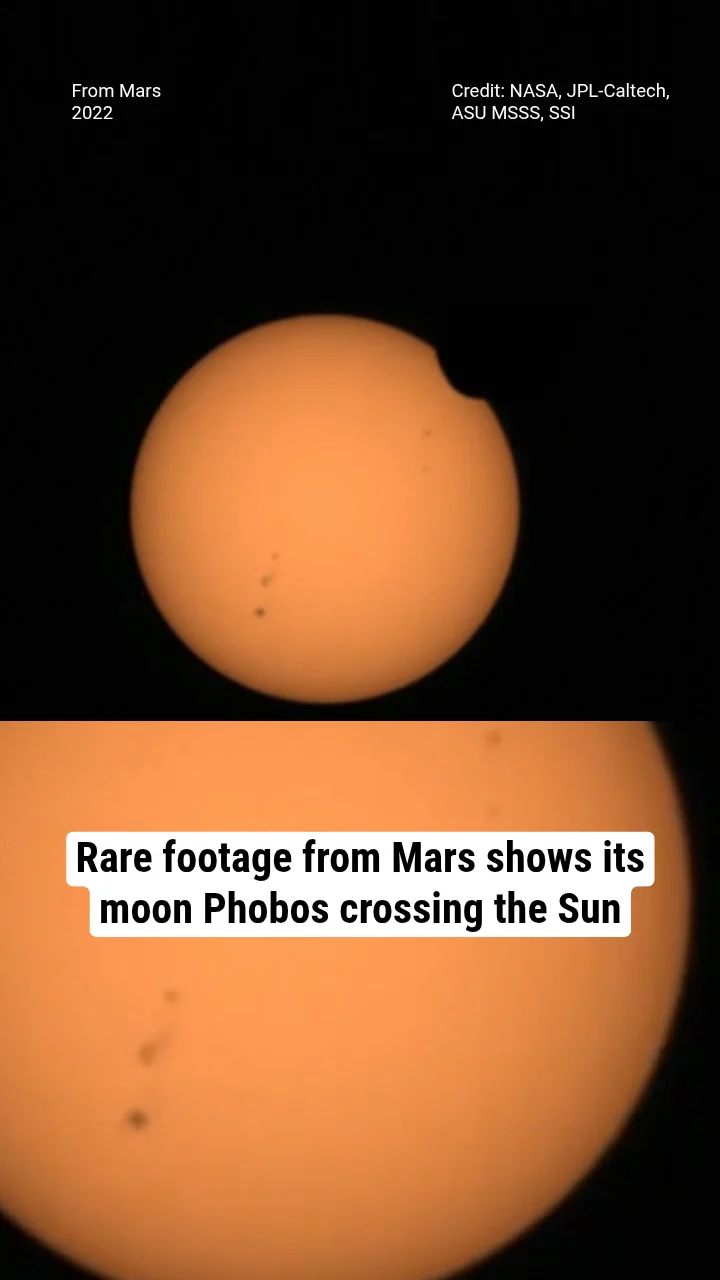 0:27
Rare footage from Mars shows its moon Phobos crossing the Sun
This clip was recorded in 2022 by NASA’s Perseverance rover on Mars. The footage is significant because it shows Mars’ largest moon, Phobos, crossing in front of the Sun in real time. The original transit lasted about 40 seconds in real time, but the footage has been sped up by the Starlust team for resharing. Key facts: • Phobos is just 11.5 km wide, making it about 150 times smaller in diameter than Earth’s Moon. • Despite its smaller size, Phobos orbits nearly 50 times closer to Mars than our Moon does to Earth. • Its close orbit causes much faster solar eclipses on Mars than those seen on Earth. • Scientists believe Phobos may eventually break apart or crash into Mars within the next 50 million years Video credit: NASA / JPL-Caltech / ASU / MSSS / SSI
 1:54
Back in 2021, Tom Cruise interviewed Victor Glover long before Artemis II
When one Maverick meets another. Back in November 2021, Tom Cruise sat down with NASA astronaut Victor Glover during the World Extreme Medicine conference, shortly after Glover returned from his long-duration mission aboard the International Space Station. What makes this conversation even more fascinating today is that, at the time, Glover hadn’t even been selected for NASA’s Artemis II mission yet. Years later, he would go on to become the pilot of humanity’s first crewed mission around the Moon since Apollo. In the conversation, the two dive into how astronauts adapt to microgravity during both routine daily activities and more dynamic situations in spaceflight, while also bonding over their shared love for fast aircraft, aviation, and Top Gun.
 1:58
NASA’s Psyche spacecraft captures incredible photos during Mars flyby
NASA’s Psyche mission just captured breathtaking new images of Mars during a crucial gravity assist flyby on May 15, as the Psyche spacecraft continued its journey toward the metal-rich asteroid Psyche deep in the asteroid belt. During the Mars flyby, the spacecraft passed just 4,500 kilometers above the planet while taking thousands of detailed pictures of craters, icy polar regions, wind streaks, and the giant Valles Marineris canyon system. The expert featured in the video is Jim Bell, professor in the School of Earth and Space Exploration at Arizona State University and imaging lead for NASA’s Psyche mission to asteroid Psyche. The images captured during the flyby include stunning crescent views of Mars, close-up shots of the Huygens crater, and detailed looks at the planet’s south polar ice cap. Read full article on Starlust: https://starlust.org/nas-as-psyche-spacecraft-captures-stunning-views-of-mars-on-its-way-to-the-metal-rich-asteroid-see-pics/ Video edited using images and footage owned by NASA/ JPL-Caltech / ASU, Associated Press.
 0:47
SpaceX Starship V3 explodes after a successful Indian Ocean splashdown
SpaceX’s Starship V3 nailed a splashdown in the Indian Ocean on two engines, survived reentry without major heat shield damage, and then tipped over and exploded exactly as planned. It proved to be a key test milestone as Starship will serve as the lander for NASA's Artemis IV crewed moon landing mission. Video Courtesy: SpaceX
 1:42
"You all never went to space": Conspiracy theorist confronts Artemis II astronauts
A viral video showing a conspiracy theorist confronting NASA’s Artemis II astronauts at the U.S. Capitol is drawing major attention online. The man, identified online as Joseph Phillip Daniel, accused Artemis II crew members Reid Wiseman, Victor Glover, Christina Koch, and Jeremy Hansen of faking their Moon mission, while repeating familiar NASA conspiracy theory claims often linked to “moon landing staged” narratives and NASA deniers. Despite the aggressive accusations, the astronauts remained calm, with Artemis II pilot Victor Glover simply responding, “Take care.” The confrontation has reminded many of the long history of conspiracy theories surrounding NASA space missions — from Apollo moon landing hoax claims decades ago to modern misinformation targeting Artemis and lunar exploration today.
 1:13
Nicki Minaj's unexpected appearance at SpaceX’s Starship launch attempt
Nicki Minaj showed up for her first-ever live rocket launch at SpaceX’s Starship test on May 21, 2026, but the mission was scrubbed moments before liftoff. Still, at Starbase, she gave a shout-out to CEO Elon Musk and shared a special message for him. Video courtesy: SpaceX