 0:52
July 2026 skywatching guide: Every major celestial event to watch this month
A complete guide to the night sky in July 2026 From Earth reaching its farthest point from the Sun to a close encounter between Mars and Uranus in the predawn sky, July has plenty in store for skywatchers. You can also follow the month's lunar phases, including the Full Buck Moon, and watch for meteors from the Southern Delta Aquariids and Alpha Capricornids showers. In this quick guide, we'll show you the biggest sky events of the month and exactly when to look up. Stay tuned to Starlust for more updates on skywatching.
More Videos
 0:43
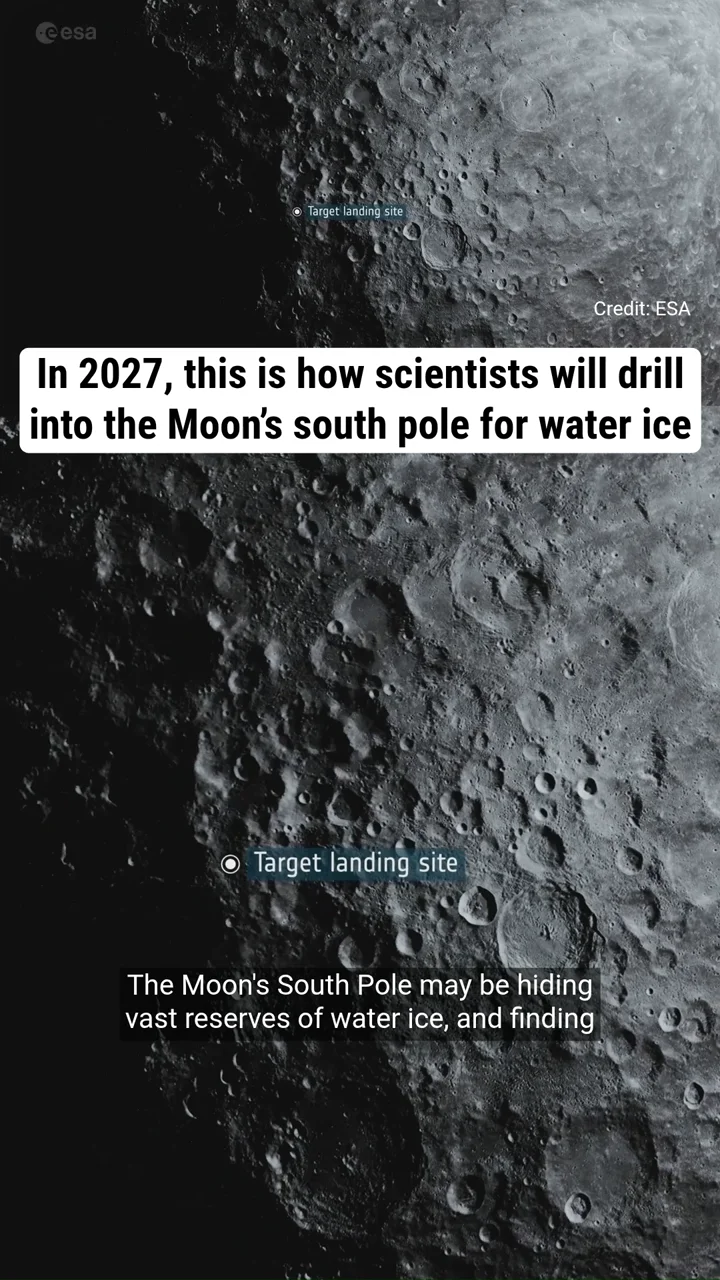
In 2027, this is how scientists will drill into the Moon’s south pole for water ice
Is there water hiding under the Moon’s surface? And how are we going to drill for it? In 2027, ESA’s Prospect mission will head to the Moon’s south pole to look for water ice locked beneath the frozen ground. Using the ProSEED drill and the ProSPA mini lab, it will dig below the surface, collect samples, and search for volatile resources that could one day provide water, oxygen, and rocket fuel. Prospect will ride to the surface aboard Intuitive Machines’ Nova-C lander on the IM-4 mission as part of NASA’s CLPS programme, with operations lasting about one lunar day, or 10 Earth days. Prospect stands for Package for Resource Observation, in-Situ Prospecting for Exploration, Characterisation & Testing. Video credit: ESA/ATG Medialab
 1:18
Rare footage captures Artemis II astronauts' first moments after returning to Earth
After traveling beyond the Moon, the Artemis crew waited inside Orion as recovery teams approached in the Pacific Ocean. Then the hatch opened. From inside the spacecraft, astronauts watched helicopters fly overhead while recovery crews welcomed them home. Outside, U.S. Navy divers became the first people to reach the capsule. Commander Reid Wiseman summed up the moment perfectly: "It was as good as it gets." Video Credit: U.S. Navy
 0:29
Artemis II astronauts' workout routine on their journey around the Moon
How do astronauts stay fit on the way to the Moon? During the 10-day Artemis II mission in April, the Orion crew spent about 30 minutes a day exercising with the compact Flywheel device, designed specifically for deep-space travel. About the size of a carry-on suitcase and weighing just 30 pounds, the power-free system delivers both aerobic and resistive workouts with loads up to 400 pounds using a simple yo-yo-like mechanism. The lightweight exercise equipment helps maintain astronaut health and muscle strength inside Orion, where space and mass are limited and traditional gym machines aren't an option. Video credit: NASA.
 1:00
How to send your name into deep space with NASA’s Roman Space Telescope
Claim your Roman Telescope boarding pass here: https://my.nasa.gov/specialevents/s/send-your-name-with-nancy-roman NASA is giving space enthusiasts a chance to send their names aboard the Nancy Grace Roman Space Telescope. Your name will travel in an SD card with the observatory as it heads nearly a million miles from Earth to the Sun-Earth L2 point, where it will observe the infrared universe. Roman will explore dark energy, dark matter, and thousands of distant worlds, making it one of NASA’s next great journeys into the cosmos.
 0:44
Ariane 6 launch best moments from Europe's most powerful rocket launch yet
Europe's Ariane 6 just flew with its more powerful boosters — and carried the heaviest payload taken to space in one go by a European launcher. Here are some key mission highlights: - First-ever flight with the new P160C boosters, each holding 14 tonnes more propellant than the previous version - Carried 36 satellites for Amazon's Leo constellation, the most satellites on a single Ariane 6 launch so far - Set a new payload weight record for Europe's heavy-lift rocket - Lifted off from Europe's Spaceport in French Guiana on 17 June, 2026 - All 36 satellites deployed into orbit within just under 2 hours of liftoff - Brings the total to 100 Amazon Leo satellites launched by Arianespace to date Footage: © European Space Agency – ESA
 0:47
Watch: Deer scatter as fireball 16 times brighter than Venus streaks across U.S. sky
A bright fireball lit up the skies over the central United States on the night of June 14, 2026, drawing hundreds of eyewitness reports from Alabama, Arkansas, Georgia, Iowa, Illinois, Kansas, Kentucky, Minnesota, Mississippi, Missouri, Oklahoma, South Carolina, Tennessee, and Texas. According to an analysis of eyewitness reports and camera data, the meteor first became visible about 60 miles above Tupelo, Mississippi, traveling northwest at an incredible 56,000 mph. It blazed through roughly 300 miles of atmosphere before completely disintegrating 34 miles above Missouri's Mark Twain National Forest. At its peak brightness, the fireball was estimated to be 16 times brighter than Venus, making it one of the most spectacular meteor events reported in the region. Scientists believe the object was a small asteroid fragment measuring about 3 inches across and weighing roughly one pound. Despite its brightness, it was too small and too fast to survive its journey through Earth's atmosphere, leaving no meteorites behind. The event was recorded by three NASA meteor cameras, as well as numerous security cameras, dashcams, smartphones, and eyewitnesses across the region. This video was recorded by Melinda and Stephen Grider on the night of June 14, 2026. © Copyright Notice: The video footage remains the property of Melinda and Stephen Grider (https://www.youtube.com/@MelindaGrider). Any reuse, redistribution, reproduction, broadcast, or publication of this clip requires their prior permission. Note: No edits have been made to the original footage by the Starlust team.
 1:03
Will Blue Origin be mission-ready for Artemis III? Here's a status update
Blue Origin says its lunar lander program is making steady progress, with multiple Mark I and Mark II vehicles now in production for future Artemis missions. The first Mark I lander is nearing the end of testing and is expected to launch later this year, helping validate key technologies such as the BE-7 engine. For Artemis III, the company is building the lunar crew module, docking systems, reaction control systems, and life support hardware needed for NASA astronauts. The mission will test critical operations in Earth orbit ahead of future Moon landings, with Blue Origin aiming to have its Artemis III vehicle ready for launch in 2027. Read full article on: https://starlust.org/moon-landers-for-artemis-iii-space-x-blue-origin-provide-progress-updates-at-nasa-event/
 0:12
NASA captures meteor fireball streaking from Mississippi to Missouri over Huntsville
A bright #fireball lit up the night sky, putting on a stunning show as it raced across several states. Captured from Huntsville, Alabama by a #NASAMarshall meteor camera at 10:26 p.m. CDT on June 14, 2026, the event tracked a fast-moving streak traveling from #Mississippi toward #Missouri. Many people were able to capture the event on their cameras. Video Credit: NASA Marshall #meteor #meteorfireball #mississippimeteor #huntsvilllemeteor
 1:10
Europe finally has its rocket back. Now comes the hard part
Ariane 6 is flying again, and Europe is preparing its most powerful version yet. But launching a rocket is only the beginning. To compete with SpaceX and maintain independent access to space, Europe now faces its biggest challenge: proving Ariane 6 can deliver again and again.
 1:55
NASA's Fermi reveals the hidden engine of a rare superluminous supernova
NASA’s Fermi Gamma-ray Space Telescope has provided a glimpse into one of the universe’s most extreme stellar explosions. By detecting gamma rays from a superluminous supernova, scientists gathered new evidence that a rapidly spinning magnetar may be injecting enormous amounts of energy into the expanding debris. The discovery helps explain why some supernovae shine far brighter than normal and offers fresh insight into the life cycle of massive stars. It also reveals a new type of gamma-ray source, opening another window into the high-energy universe. Credit: NASA's Goddard Space Flight Center/Scientific Visualization Studio
 1:23
Why NASA still can't bring Mars samples home
NASA already has some of the most valuable rock samples in human history waiting on Mars. Collected by the Perseverance rover, these samples could reveal whether ancient microbial life once existed on the Red Planet. But there is one problem: bringing them back to Earth is proving far harder than collecting them. With rising costs and technical hurdles slowing the Mars Sample Return mission, NASA faces one of the biggest challenges in modern space exploration. Video edited using footage owned by NASA Royalty free music from Hook Sounds
 1:00
Rare clip shows Venus crossing the Sun, won't happen again until 2117
NASA's Solar Dynamics Observatory (SDO), on June 5, 2012, captured one of the rarest predictable events in astronomy: Venus passing directly across the face of the Sun. Known as a Venus Transit, this event occurs in pairs separated by eight years, but those pairs themselves are separated by more than a century. Before 2012, the transit occurred in 2004, and the next won't take place until 2117. This stunning footage combines multiple wavelengths of light, including ultraviolet views that reveal parts of the Sun's atmosphere invisible to the human eye. Did you witness the 2012 transit? What was your favorite moment? Comment below! Video Credit: NASA/SDO Audio Credit: Royalty-free music from HookSounds