'Listen' to Jupiter, Saturn and Uranus ahead of the six-planet parade on February 28
![Screenshot from the scan of Saturn as it sweeps to the left. One can hear a siren effect whose frequency follows the arc of the rings. [Representative Image Source: NASA | CXC | SAO | K.Arcand, SYSTEM Sounds (M. Russo, A. Santaguida)]](https://d3hedi16gruj5j.cloudfront.net/793130/uploads/aa0c3410-12f5-11f1-b268-eb996b5b9680_1200_630.jpeg)
For centuries, planetary observations of our solar system relied on our sense of sight. With time, thanks to advancements in astronomy, we have expanded our scope beyond the limits of what our eyes can see. This means that we can now observe our universe in X-rays and infrared. These forms of electromagnetic radiation coming from objects in the sky or reflected by planets, while being invisible to us, can now be interpreted into visual forms. These images help us characterize the properties of far-off worlds and their environments with greater depth. However, scientists have now devised an entirely new way of observing planets in our solar system.
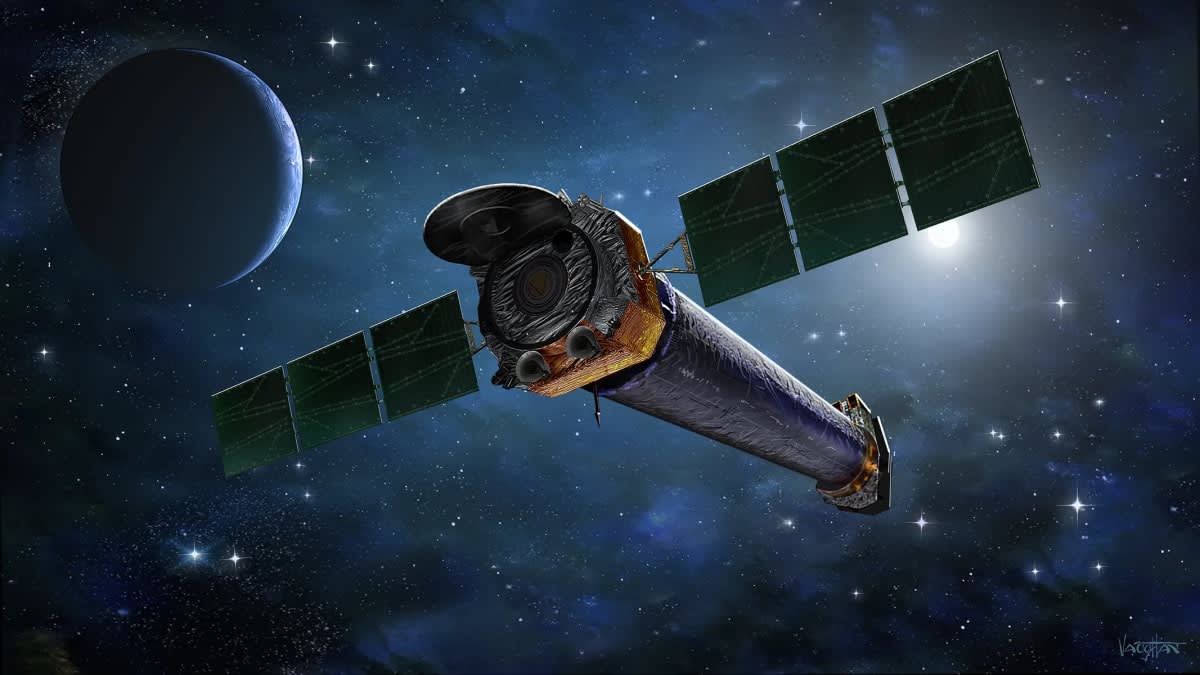
This is a method that, instead of producing images for our eyes to see, indulges our sense of hearing. In commemoration of the six-planet parade that is set to grace our skies on February 28, NASA has released tracks of sounds representing some of the participant planets. A process called 'sonification' saw the sound from each planet created from data collected by the Chandra X-ray Observatory in conjunction with other telescopes. X-rays projected by the Sun bounce off the planet and other celestial bodies around it. Data from these rays is sent to Earth as binary code, which is then transformed into sounds.
Curious what 22 years of Chandra observations sound like? This sonification includes every Chandra observation from 1999 - 2021. 🎵 pic.twitter.com/nHpw62trbZ
— Chandra Observatory (@chandraxray) January 25, 2026
The first sound, representing Jupiter and its surroundings in space, was a composite of X-ray data from Chandra and infrared data from the Hubble Space Telescope. Chandra's X-ray data, which includes emission from Jupiter's auroras, is represented via the woodwind sound, while the planet's complex cloud layers can be heard as other instruments.
The sonification of Saturn was processed by gathering data from Chandra as well as visible light data from the Cassini spacecraft. The sounds of Saturn’s spectacular rings are remarkable in their own right, with a scanning line moving right to left to produce a sound effect that resembles gusts of wind with siren sounds for the oval-shaped rings. The data from the planet also manifests itself as neon blue X-ray spots, which trigger synthesizer tones. As the scan passes through the planet's body itself, a deep sound is produced.
Data for Uranus came from images from the W.M. Keck Observatory and Chandra. This sonification track represents the greenish world tilted on its side and circled by faint rings. As the activation line scans from left to right, its intersection with the planet produces a deep sound like Saturn’s. However, the scan of its rings produces a noise similar to the exhaust of a superbike.
Peaking on February 28th in the Northern Hemisphere, six planets will all be visible from clear & dark night skies. In celebration of this planetary group project, Chandra is releasing three new planetary sonifications. Experience the data-driven sounds of Uranus: pic.twitter.com/1uzY3Eg6Jn
— Chandra Observatory (@chandraxray) February 25, 2026
The Chandra X-ray Observatory has been on the lookout for deep space objects since 1999. Cassini was launched to supply details of Saturn and its moons in 1997. Hubble was launched in 1990 and has been credited with having changed humanity’s understanding of the universe with its brilliant pictures of nebulae and galaxies. The W.M. Keck Observatory is located in Hawaii and produces optical and infrared images.
While sonification is said to protect the integrity of the data coming from the observatories mentioned above, this release has purposes greater than science. In a bid to make its wondrous observations accessible to everyone, NASA felt the need to translate data into sounds.
More on Starlust
NASA's Chandra spots a young 'Sun' blowing bubbles for the first time
NASA's Hubble Space Telescope detects a faint galaxy that is almost entirely dark matter