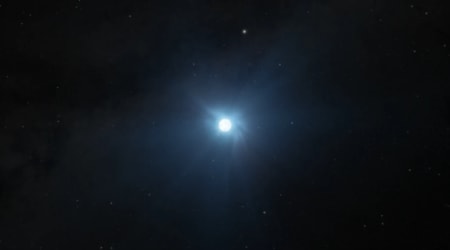
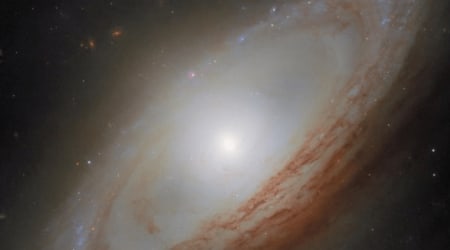
Lagoon Nebula

On a clear, dark night, look about 5° (two finger-widths) west of 3rd-magnitude Lambda Sagittarii, the star that marks the top of the easily recognizable asterism called the Teapot. You will surely notice a bright comet-like patch, similar in size to the well-known Orion Nebula.
This is M8, nicknamed the “Lagoon Nebula“, a vast cloud of interstellar gas and dust more than 50 light-years across and about 5,700 light-years distant. M8 is a fine example of an H II region: an emission nebula in which strong ultraviolet radiation from two very hot stars – 6th-magnitude 9 Sagitarii and 9th-magnitude Herschel 36 – excites surrounding hydrogen gas and causes it to glow.
The nebula is complemented on its eastern side by NGC 6530 – a loose open star cluster composed of more than a hundred known bright members and hundreds of fainter members probably accompanying them. The cluster’s stars are less than 5 million years old, practically brand new by astronomical standards.
Discovery of the Lagoon Nebula is often credited to the French astronomer Legentil de La Galaisiere in 1747, though it seems that it was first noted by John Flamsteed as early as 1680. The word “lagoon” was probably first used in association with M8 by Agnes Clerke, in the first edition of her book The System of the Stars in 1890. The name refers to the curving dark furrow that cuts nearly through the middle of the nebula, dividing it in half. However, the name does not seem entirely appropriate, as the central dark feature resembles a channel rather than a lagoon.
In addition to the dark channel, M8 shows a wealth of detail in small telescopes. There are numerous other smaller dust clouds scattered here and there against the bright background, and with moderate magnification brighter knots of nebulosity are easily discernible in some parts of the nebula.
The full complexity of the Lagoon Nebula is brought out only with a nebula or light-pollution filter. You can get wonderful views by using narrow-band filters such as Lumicon’s UHC and Orion’s Ultrablock. Keep in mind that you must shade your eye by using a dark cloth or cupping your hands. Otherwise, stray light enters the eyepiece, bounces off the filter, and overwhelms the nebula.
Lagoon Nebula’s surrounding region contains many fine objects for amateur telescopes, so make sure you check them all. Just half a degree north lies another prominent diffuse nebula, M20, the “Trifid”, in the same low-power field with the open star cluster M21. Sweeping an area 1° southeast of M8, you may be able to detect the very remote globular cluster NGC 6544, and maybe even NGC 6553; another globular located one more degree to the southeast.