China's Shenzhou-23 astronauts harvest rice samples grown from space seeds on Tiangong station
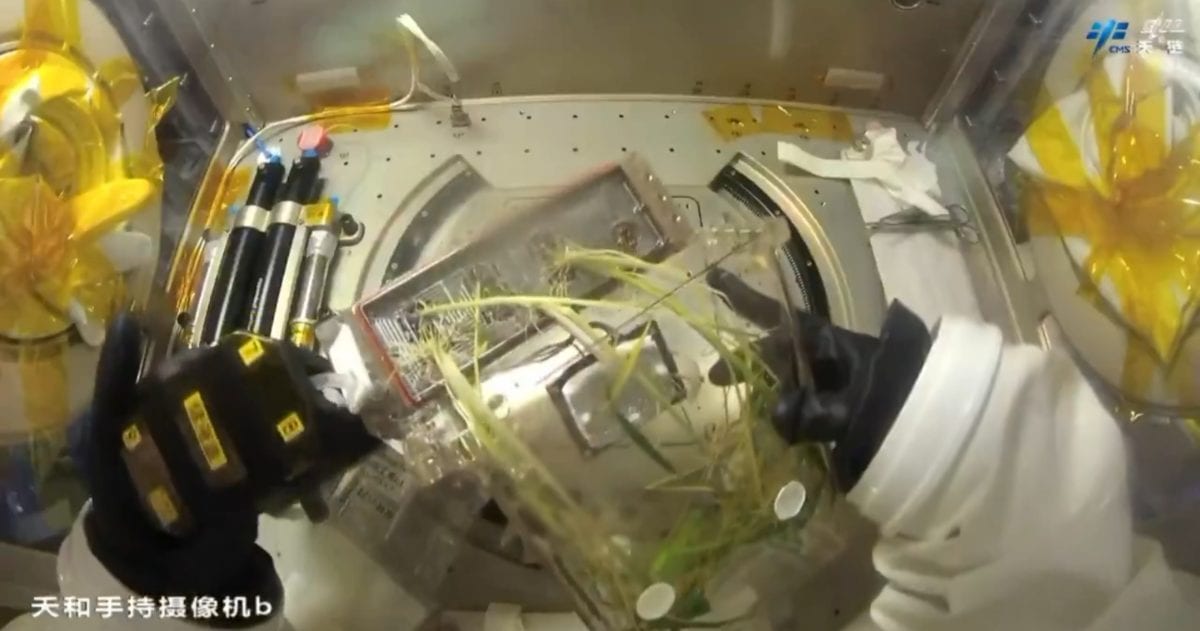
Taikonauts from the Shenzhou-23 crew aboard China's Tiangong space station are trying to grow two successive generations of rice in space. After harvesting first-generation seeds in August, the crew has made considerable progress in what is the country's first multigenerational rice-cultivation experiment in orbit by collecting a new round of rice samples, sowing, and storing them.
The Shenzhou-23 crew has made new progress in China’s first multi-generational rice cultivation in orbit. A fresh round of sample collection, sowing and storage is complete aboard Tiangong. #Tiangong #ChinaSpace https://t.co/ybCTccTMP9
— Chinese Mission to UN (@Chinamission2un) October 20, 2026
China's intriguing project intends to cultivate two back-to-back generations of rice completely under microgravity conditions. The results would enable researchers to analyze how long-term microgravity conditions in space can impact the ability of crops to reproduce and sustain genetic stability. Eventually, the project's goal would be to discover a way to grow food entirely in space without the need to rely on supply missions from Earth. According to the Chinese Academy of Sciences, "this trial represents a critical step toward establishing in situ food production technology for extraterrestrial environments, laying the foundation for sustainable grain production in future deep-space exploration missions, including those on the Moon and Mars."
🌾🛰️🔬More than two months after arriving @CNSpaceStation, the Shenzhou XXIII mission crew has harvested the first batch of experimental rice samples after meticulously cultivating the plants in orbit. The experiment aims to achieve the world's first continuous cultivation of two generations of rice in orbit, completing two consecutive life cycles. [📷/CMS]
— Chinese Space Station (@CNSpaceStation) August 7, 2026
This is not the first instance of rice being cultivated on the Tiangong space station. Earlier, in 2022, members of the Shenzhou 14 mission demonstrated the world's first-ever complete life cycle rice cultivation in space using the Wentian lab module of the space station. The astronauts cultivated six seeds of rice in orbit for 120 days, yielding 59 first-generation rice seeds in space. These seeds were then brought back to Earth along with the crew members and subsequently propagated on Earth for three generations. That said, despite showing a good ability for reproduction, the seeds displayed poor orientation—rather than sprouting upward, the seeds stayed flat while germinating. Zheng Huiqiong, who's the leader of the research team from the Chinese Academy of Sciences that has been conducting this experiment, attributed this behavior to the effect of microgravity on the plants, referring to the phenomenon as "space syndrome."
Working through the National Day holiday, the #ShenzhouXXIII crew aboard @CNSpaceStation is keeping science and station operations on track. 🇨🇳🚀 Take a peek at life in orbit! [📹/CMS] https://t.co/w0P8fglCLi
— Chinese Space Station (@CNSpaceStation) October 13, 2026
The researchers working on this project are also comparing ordinary seeds with the descendants of the rice grown in space in 2022. The comparison could reveal whether previous exposure to the space environment influences how plants adapt to microgravity. The second generation of space rice is expected to achieve maturity during the Shenzou-24 mission. Alongside the rice experiment, the taikonauts recently tested Xiaohang, their robotic companion, to study how it responds to physical touch and boost its motion planning. They also performed evaluations of emergency decision-making and emotional states to help researchers understand how these may alter during extended stays in space.
Despite the progress made by the taikonauts with rice growth aboard the Tiangong space station, it will be a while before we know for sure whether the technology can be transferred to the Moon or Mars. After all, there is a huge difference between the environment on a space station and the one on another celestial body.
More on Starlust
Long-term space travel significantly deforms the human brain, new study finds
NASA awards U.S. woman $300,000 for devising space food system to feed astronauts on Mars